Technical Information · issue 32 of 1994
Service: STIHL ZAT 3 ignition tester
Service-tool changes & notes
Source-reviewed tool relationships, not saw-model compatibility or a verified kit inventory. Availability statements belong to the bulletin’s date.
Service note · Service tool
ZAT 3: 6 mm main-gap ignition test without running the engine
Remove the spark plug; ground the connecting-lead clip to the engine, not to the spark plug.
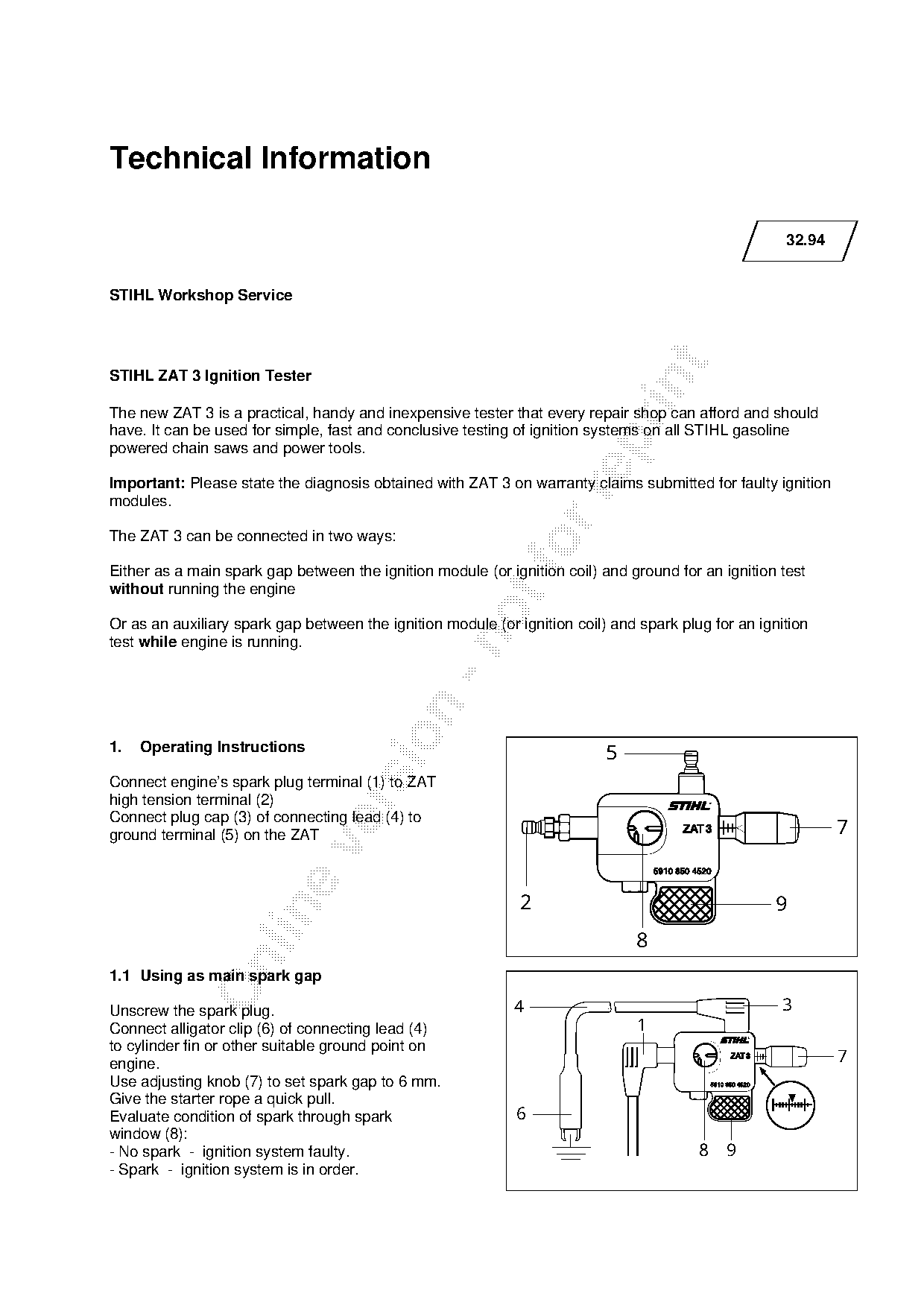
- Shared connections: engine spark-plug terminal(1) → ZAT high-tension terminal(2); connecting-lead(4) plug cap(3) → ZAT ground terminal(5). The name ground terminal does not mean clip(6) stays grounded in auxiliary mode: that mode clips to the spark plug. Tester labels1–9 and both original configuration drawings are preserved by linked source pages.
- MAIN spark gap: UNSCREW spark plug; attach clip(6) to a cylinder fin or other suitable ENGINE GROUND. Set knob(7) to 6 mm and give starter rope a quick pull. Observe window(8): source classifies NO SPARK as ignition-system faulty and SPARK as ignition-system in order. This is the bulletin’s diagnostic criterion, not a measured result or proof against every intermittent/load-dependent fault. It does not identify a specific failed module.
- Precautions on page 2 apply to BOTH modes: never use near flammable substances (fuel/gas), with wet hands, or by children/uninstructed persons. Hold ONLY the knurled handle(9); keep fingers/body at least 1 cm from spark window(8), high-tension terminal(2), ground terminal(5) and alligator clip(6). Do not turn gap knob(7) past its end position (electrode damage). In bright light blacken ONE SIDE of the window or use a dark background. Auxiliary mode can START THE ENGINE when the starter is actuated; follow tool owner’s-manual safety precautions.
- New ZAT 3 tester 5910 850 4520 is advertised for all STIHL gasoline-powered chainsaws and power tools in this 1994 bulletin; no exact model list or later-system compatibility established. MOQ H1. Historical warranty instruction: state ZAT 3 diagnosis on claims for faulty ignition modules; no claim submitted here.
- Historical TI 32/1994 guidance only. No successor or unlisted model applicability inferred. No physical interchange test was performed. No hardware operation was performed.
Source: TI 32/1994, p. 1 · TI 32/1994, p. 2 — ZAT 3: 6 mm main-gap ignition test without running the engine.
Part numbers (1)
- 5910 850 4520 — ZAT 3 ignition testernew service tool · ZAT 3: 6 mm main-gap ignition test without running the engine
Service note · Service tool
ZAT 3: 2 mm auxiliary-gap test keeps the spark plug in circuit
Steady and intermittent sparks have different diagnoses; cranking can start the engine.
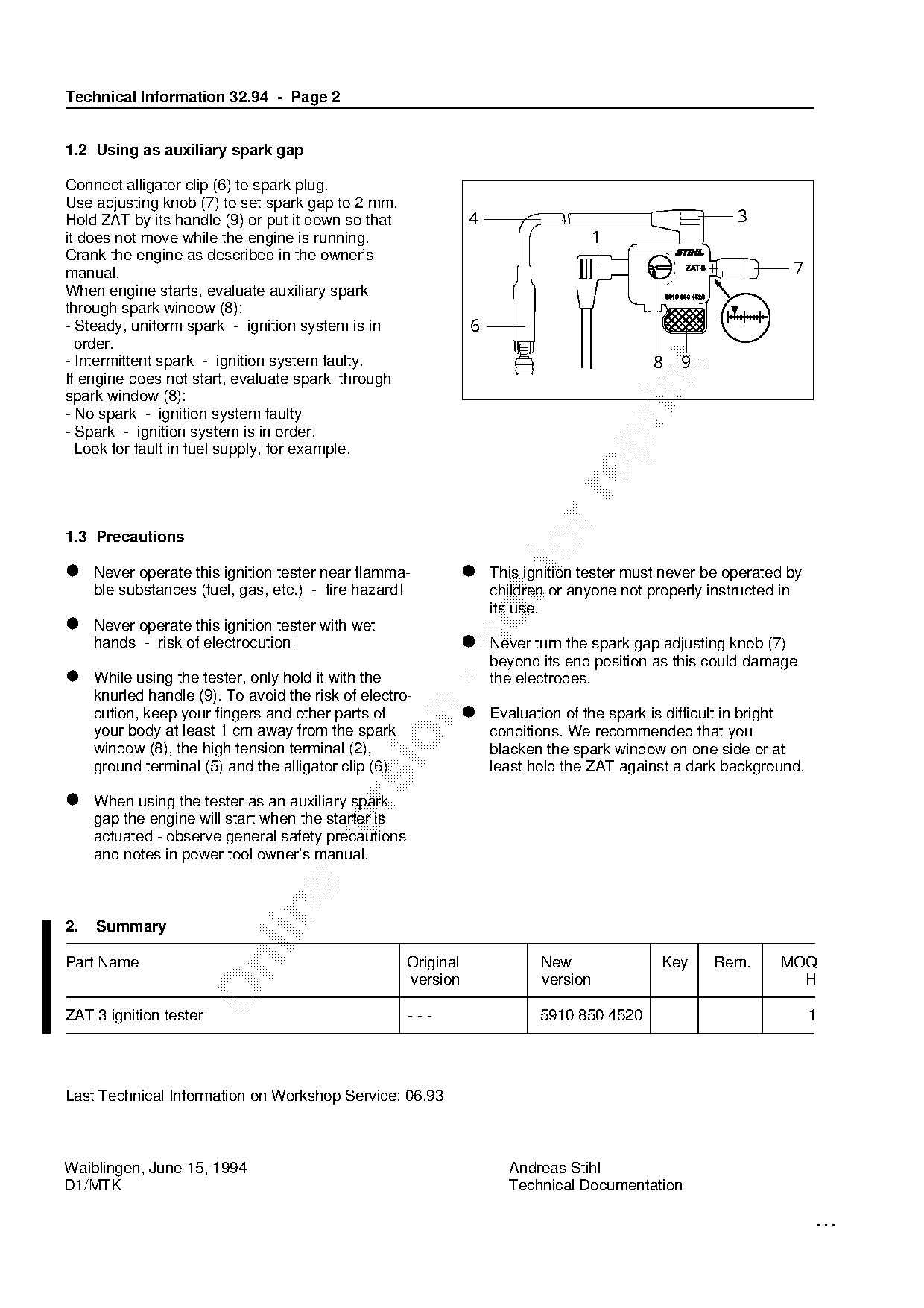
- Shared connections: engine spark-plug terminal(1) → ZAT high-tension terminal(2); connecting-lead(4) plug cap(3) → ZAT ground terminal(5). The name ground terminal does not mean clip(6) stays grounded in auxiliary mode: that mode clips to the spark plug. Tester labels1–9 and both original configuration drawings are preserved by linked source pages.
- AUXILIARY spark gap: connect clip(6) to SPARK PLUG, set knob(7) to 2 mm. Hold by handle(9) or set it down so it cannot move while engine runs. Crank per tool owner’s manual. If engine STARTS: steady uniform spark → ignition system in order; intermittent spark → faulty. If engine DOES NOT START: no spark → ignition faulty; spark → ignition in order, look for another fault such as fuel supply. Fuel supply is an example, not a proven diagnosis.
- Precautions on page 2 apply to BOTH modes: never use near flammable substances (fuel/gas), with wet hands, or by children/uninstructed persons. Hold ONLY the knurled handle(9); keep fingers/body at least 1 cm from spark window(8), high-tension terminal(2), ground terminal(5) and alligator clip(6). Do not turn gap knob(7) past its end position (electrode damage). In bright light blacken ONE SIDE of the window or use a dark background. Auxiliary mode can START THE ENGINE when the starter is actuated; follow tool owner’s-manual safety precautions.
- These are historical diagnostic criteria, not live test results or universal fault isolation. Do not interchange the 2 mm auxiliary setting with 6 mm engine-ground main-gap setting. No RPM, spark-voltage specification or modern-system equivalence supplied.
- Historical TI 32/1994 guidance only. No successor or unlisted model applicability inferred. No physical interchange test was performed. No hardware operation was performed.
Source: TI 32/1994, p. 1 · TI 32/1994, p. 2 — ZAT 3: 2 mm auxiliary-gap test keeps the spark plug in circuit.
Part numbers (1)
- 5910 850 4520 — ZAT 3 ignition testerauxiliary test configuration · ZAT 3: 2 mm auxiliary-gap test keeps the spark plug in circuit
Full text
Page 1 of 2
Text of page 1 — search, copy, screen readers
Technical Information

                                                                                                      32.94

STIHL Workshop Service

STIHL ZAT 3 Ignition Tester

The new ZAT 3 is a practical, handy and inexpensive tester that every repair shop can afford and should
have. It can be used for simple, fast and conclusive testing of ignition systems on all STIHL gasoline

powered chain saws and power tools.

Important: Please state the diagnosis obtained with ZAT 3 on warranty claims submitted for faulty ignition

modules.

The ZAT 3 can be connected in two ways:
Either as a main spark gap between the ignition module (or ignition coil) and ground for an ignition test
without running the engine

Or as an auxiliary spark gap between the ignition module (or ignition coil) and spark plug for an ignition

test while engine is running.

1.   Operating Instructions
                                                                           5
Connect engine’s spark plug terminal (1) to ZAT
high tension terminal (2)

Connect plug cap (3) of connecting lead (4) to
ground terminal (5) on the ZAT                                                                                7

                                                              2                                      9


1.1 Using as main spark gap

Unscrew the spark plug.                                      4                                        3
Connect alligator clip (6) of connecting lead (4)                               1
to cylinder fin or other suitable ground point on
engine.                                                                                                       7
Use adjusting knob (7) to set spark gap to 6 mm.
Give the starter rope a quick pull.
Evaluate condition of spark through spark                    6
window (8):
- No spark - ignition system faulty.                                                     8   9
- Spark - ignition system is in order.
Page 2 of 2
Text of page 2 — search, copy, screen readers
Technical Information 32.94 - Page 2

1.2 Using as auxiliary spark gap

Connect alligator clip (6) to spark plug.
Use adjusting knob (7) to set spark gap to 2 mm.
Hold ZAT by its handle (9) or put it down so that                  4                                         3
it does not move while the engine is running.                                            1
Crank the engine as described in the owner’s
manual.                                                                                                                7
When engine starts, evaluate auxiliary spark
through spark window (8):
- Steady, uniform spark - ignition system is in                    6
  order.
- Intermittent spark - ignition system faulty.                                                    8   9

If engine does not start, evaluate spark through

spark window (8):
- No spark - ignition system faulty
- Spark - ignition system is in order.

  Look for fault in fuel supply, for example.

1.3 Precautions

• Never  operate this ignition tester near flamma-                • This
                                                                         ignition tester must never be operated by
  ble substances (fuel, gas, etc.) - fire hazard!                   children or anyone not properly instructed in
                                                                       its use.
•    Never operate this ignition tester with wet
                                                                  • Never

     hands - risk of electrocution!                                       turn the spark gap adjusting knob (7)

• While
                                                                    beyond its end position as this could damage
        using the tester, only hold it with the                        the electrodes.
  knurled handle (9). To avoid the risk of electro-
                                                                  • Evaluation

     cution, keep your fingers and other parts of                               of the spark is difficult in bright
     your body at least 1 cm away from the spark                    conditions. We recommended that you

     window (8), the high tension terminal (2),                        blacken the spark window on one side or at
     ground terminal (5) and the alligator clip (6).                   least hold the ZAT against a dark background.

• When  using the tester as an auxiliary spark

  gap the engine will start when the starter is
     actuated - observe general safety precautions

     and notes in power tool owner’s manual.

2.   Summary

Part Name                                              Original                   New             Key     Rem.        MOQ
                                                       version                    version                               H

ZAT 3 ignition tester                                  ---                        5910 850 4520                            1

Last Technical Information on Workshop Service: 06.93

Waiblingen, June 15, 1994                                                 Andreas Stihl
D1/MTK                                                                    Technical Documentation

                                                                                                                           ...
Most of these PDFs embed fonts with a shifted character map, so the text above was recovered rather than copied — read it as a faithful but imperfect transcription, and treat the page image above each block as the authority where the two disagree — the figures exist only there, because they are vector drawings that text extraction cannot keep.