Technical Information · issue 4 of 1996
Oilomatic chains: 0.404" Rapid-Micro Harvester ;Em
IssueTI 4/1996
Full text
Page 1 of 6
Text of page 1 — search, copy, screen readers
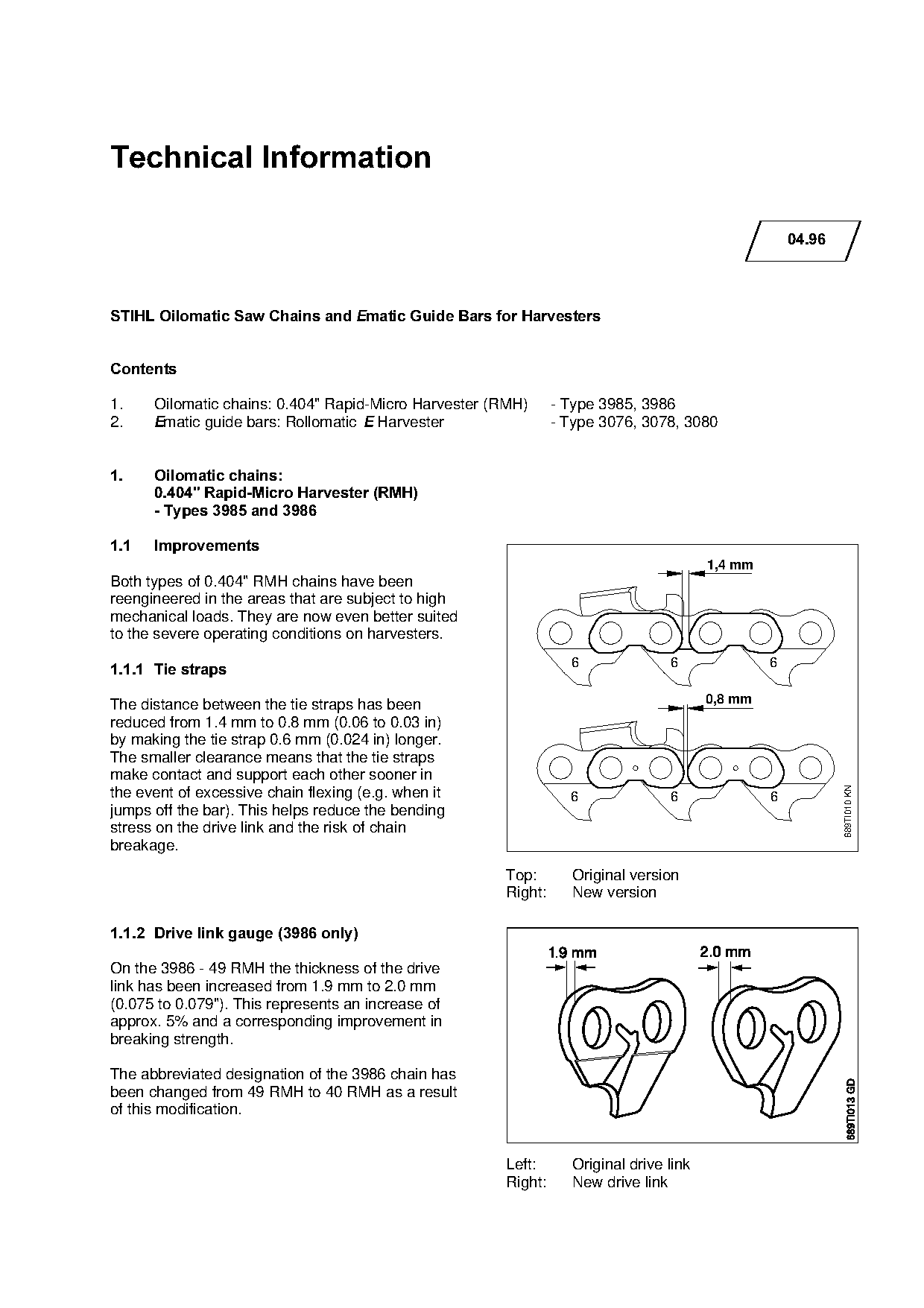
Technical Information

                                                                                                    04.96

STIHL Oilomatic Saw Chains and Ematic Guide Bars for Harvesters

&RQWHQWV

1.    Oilomatic chains: 0.404" Rapid-Micro Harvester (RMH)     - Type 3985, 3986
2.    (matic guide bars: Rollomatic =E=e~rvester               - Type 3076, 3078, 3080

1.====Oilomatic chains:
      0.404" Rapid-Micro Harvester =RMH=

======- Types 3985 and 3986

1.1===Improvements======================================fo                             1,4 mm
Both types of 0.404" RMH chains have been
reengineered in the areas that are subject to high
mechanical loads. They are now even better suited
to the severe operating conditions on harvesters.

                                                                 6              6               6
1.1.1=Tie straps

The distance between the tie straps has been                                           0,8 mm

reduced from 1.4 mm to 0.8 mm (0.06 to 0.03 in)

by making the tie strap 0.6 mm (0.024 in) longer.
The smaller clearance means that the tie straps
make contact and support each other sooner in

                                                                                                            689TI010 KN
the event of excessive chain flexing (e.g. when it               6              6               6

jumps off the bar). This helps reduce the bending
stress on the drive link and the risk of chain

breakage.
                                                      Top:       Original version
                                                      Right:     New version

1.1.2=Drive link gauge =3986 only

On the 3986 - 49 RMH the thickness of the drive
link has been increased from 1.9 mm to 2.0 mm
(0.075 to 0.079"). This represents an increase of
approx. 5% and a corresponding improvement in
breaking strength.

The abbreviated designation of the 3986 chain has
been changed from 49 RMH to 40 RMH as a result
of this modification.

                                                      Left:      Original drive link
                                                      Right:     New drive link
Page 2 of 6
Text of page 2 — search, copy, screen readers
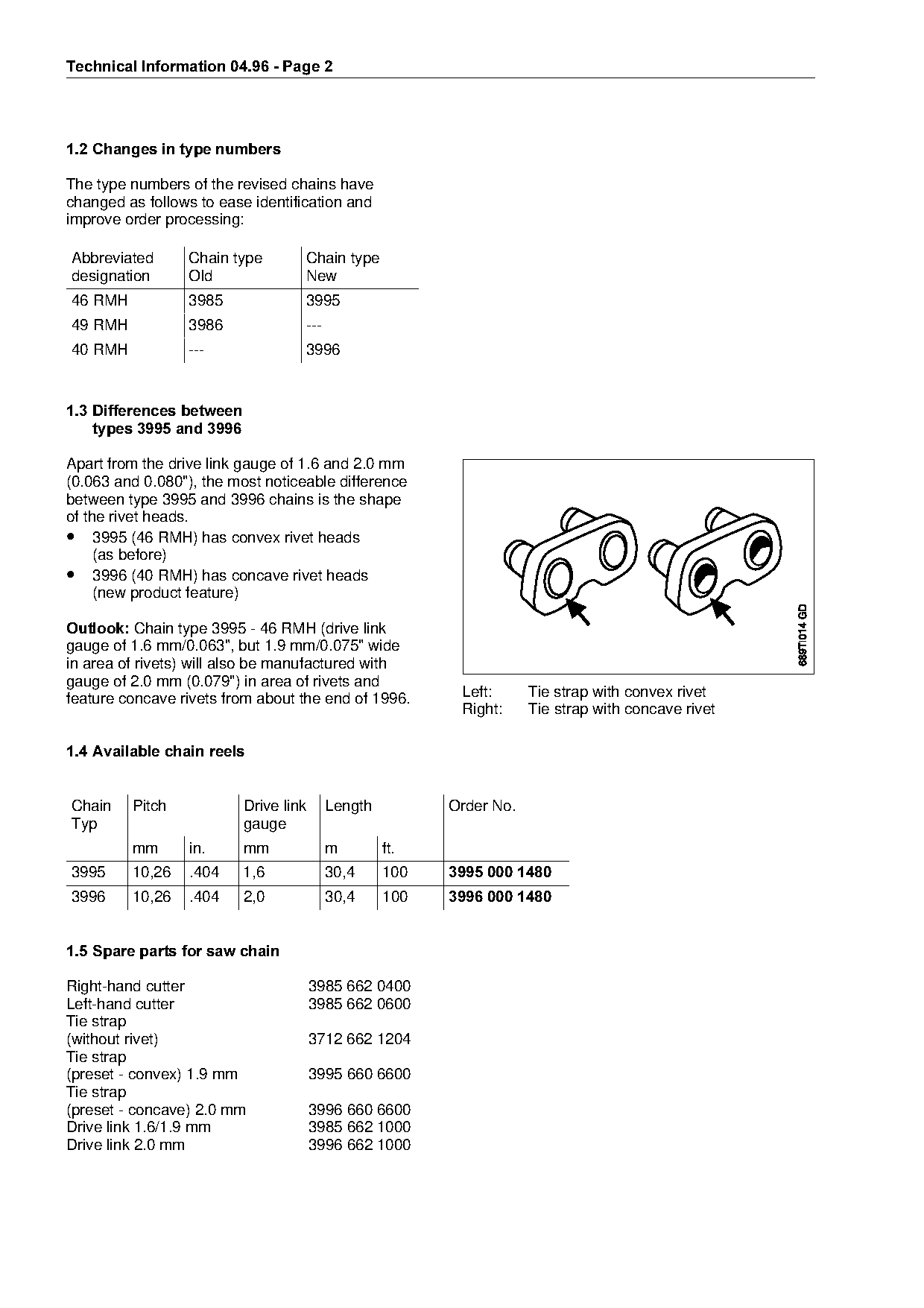
Technical Information 04.96 - Page 2

1.2=Changes in type numbers

The type numbers of the revised chains have
changed as follows to ease identification and
improve order processing:

Abbreviated      Chain type        Chain type
designation      Old               New
46 RMH           3985              3995
49 RMH           3986              ---
40 RMH           ---               3996

1.3=Differences between
====types 3995 and 3996

Apart from the drive link gauge of 1.6 and 2.0 mm
(0.063 and 0.080"), the most noticeable difference

between type 3995 and 3996 chains is the shape
of the rivet heads.
• 3995 (46 RMH) has convex rivet heads
     (as before)
• 3996 (40 RMH) has concave rivet heads
     (new product feature)

Outlook:=`hain type 3995 - 46 RMH (drive link

gauge of 1.6 mm/0.063", but 1.9 mm/0.075" wide
in area of rivets) will also be manufactured with
gauge of 2.0 mm (0.079") in area of rivets and
feature concave rivets from about the end of 1996.          Left:    Tie strap with convex rivet

                                                            Right:   Tie strap with concave rivet

1.4=Available chain reels

Chain    Pitch           Drive link      Length         Order No.
Typ                      gauge

         mm       in.    mm              m        ft.
PVVR=====NMIOS====KQMQ===NIS=============PMIQ=====NMM===3995 000 1480
PVVS=====NMIOS====KQMQ===OIM=============PMIQ=====NMM===3996 000 1480

1.5=Spare parts for saw chain

Right-hand cutter                     3985 662 0400
Left-hand cutter                      3985 662 0600
Tie strap
(without rivet)                       3712 662 1204
Tie strap
(preset - convex) 1.9 mm              3995 660 6600
Tie strap
(preset - concave) 2.0 mm             3996 660 6600
Drive link 1.6/1.9 mm                 3985 662 1000
Drive link 2.0 mm                     3996 662 1000
Page 3 of 6
Text of page 3 — search, copy, screen readers
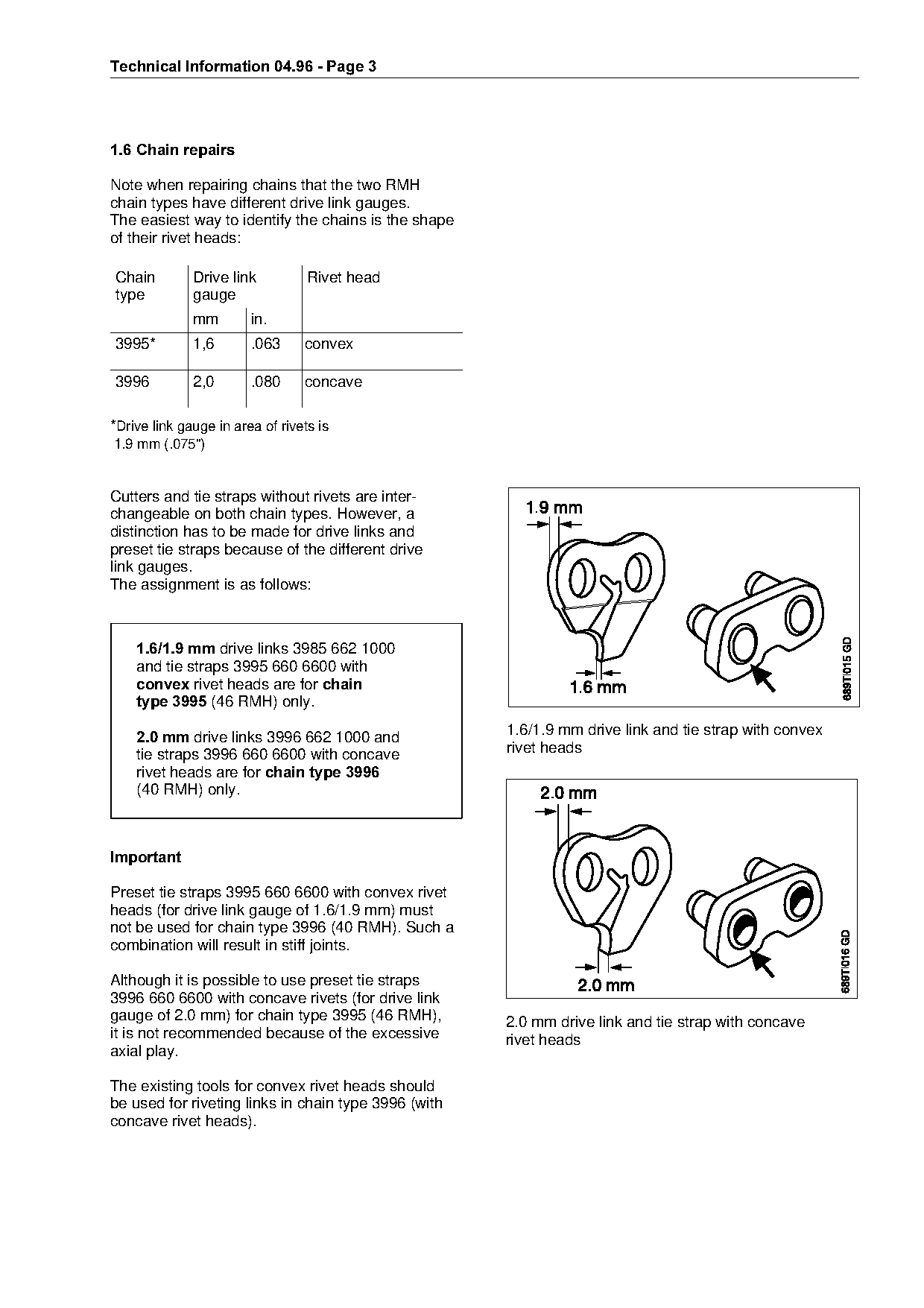
Technical Information 04.96 - Page 3

1.6=Chain repairs

Note when repairing chains that the two RMH
chain types have different drive link gauges.
The easiest way to identify the chains is the shape
of their rivet heads:

Chain         Drive link          Rivet head
type          gauge
              mm        in.
3995*         1,6       .063     convex

3996          2,0       .080     concave

*Drive link gauge in area of rivets is

1.9 mm (.075")

Cutters and tie straps without rivets are inter-
changeable on both chain types. However, a
distinction has to be made for drive links and
preset tie straps because of the different drive
link gauges.
The assignment is as follows:

    1.6/1.9 mm=drive links 3985 662 1000
    and tie straps 3995 660 6600 with
    FRQYH[ rivet heads are for chain
    type 3995=EQS=ojeF=only.

    2.0 mm=drive links 3996 662 1000 and              1.6/1.9 mm drive link and tie strap with convex

    tie straps 3996 660 6600 with concave             rivet heads
    rivet heads are for chain type 3996
    (40 RMH) only.

,PSRUWDQW

Preset tie straps 3995 660 6600 with convex rivet

heads (for drive link gauge of 1.6/1.9 mm) must
not be used for chain type 3996 (40 RMH). Such a
combination will result in stiff joints.

Although it is possible to use preset tie straps
3996 660 6600 with concave rivets (for drive link
gauge of 2.0 mm) for chain type 3995 (46 RMH),        2.0 mm drive link and tie strap with concave
it is not recommended because of the excessive        rivet heads
axial play.

The existing tools for convex rivet heads should
be used for riveting links in chain type 3996 (with
concave rivet heads).
Page 4 of 6
Text of page 4 — search, copy, screen readers
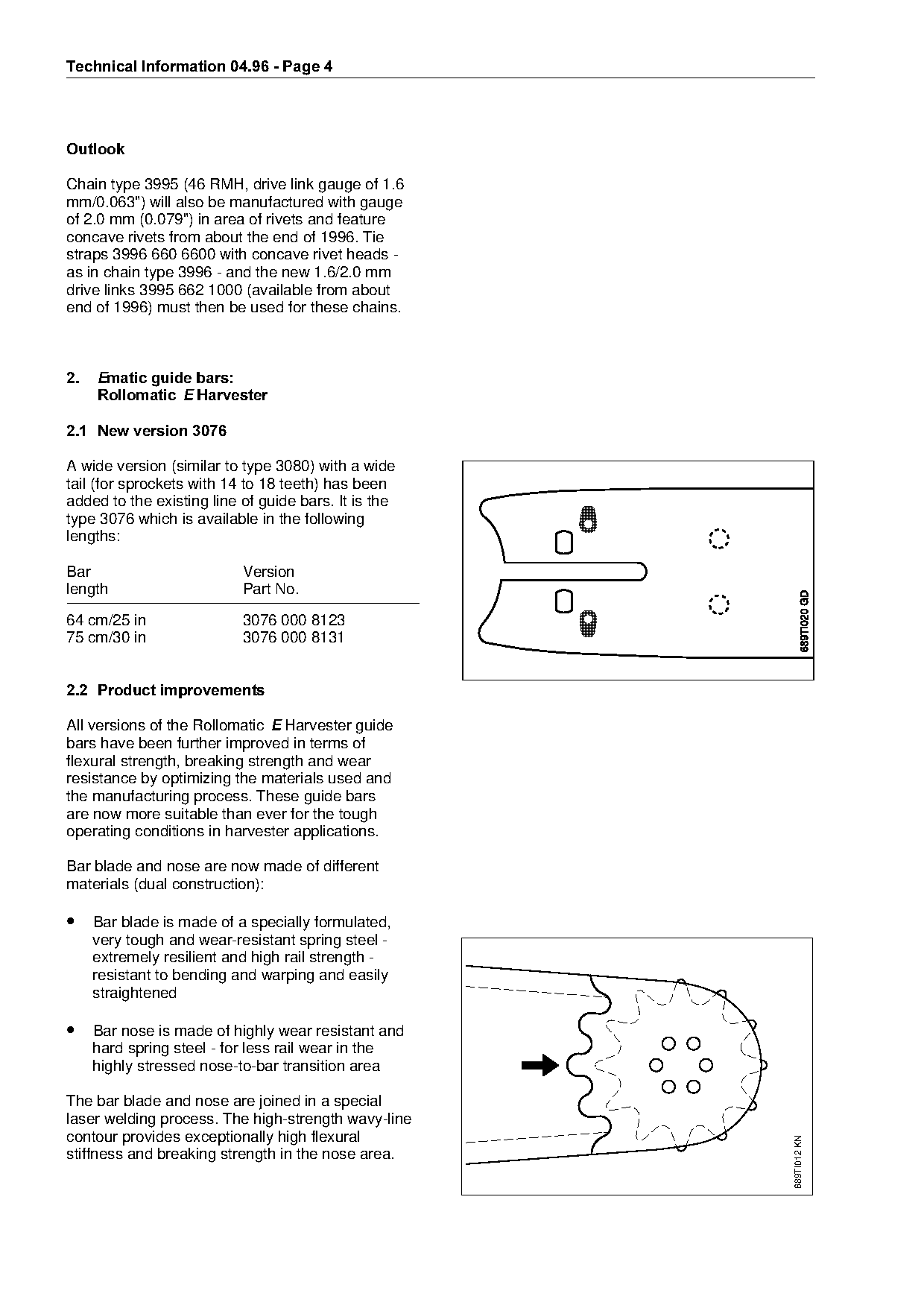
Technical Information 04.96 - Page 4

2XWORRN

Chain type 3995 (46 RMH, drive link gauge of 1.6
mm/0.063") will also be manufactured with gauge
of 2.0 mm (0.079") in area of rivets and feature
concave rivets from about the end of 1996. Tie
straps 3996 660 6600 with concave rivet heads -
as in chain type 3996 - and the new 1.6/2.0 mm
drive links 3995 662 1000 (available from about
end of 1996) must then be used for these chains.

2.===Ematic guide bars

     Rollomatic =E Harvester

2.1=New version 3076

A wide version (similar to type 3080) with a wide
tail (for sprockets with 14 to 18 teeth) has been

added to the existing line of guide bars. It is the
type 3076 which is available in the following
lengths:

Bar                         Version
length                      Part No.
64 cm/25 in                 3076 000 8123
75 cm/30 in                 3076 000 8131

2.2=Product improvements

All versions of the Rollomatic =E=e~rvester guide

bars have been further improved in terms of
flexural strength, breaking strength and wear
resistance by optimizing the materials used and
the manufacturing process. These guide bars

are now more suitable than ever for the tough
operating conditions in harvester applications.

Bar blade and nose are now made of different
materials (dual construction):

• Bar blade is made of a specially formulated,
     very tough and wear-resistant spring steel -
     extremely resilient and high rail strength -

     resistant to bending and warping and easily
     straightened

• Bar nose is made of highly wear resistant and
     hard spring steel - for less rail wear in the
     highly stressed nose-to-bar transition area

The bar blade and nose are joined in a special
laser welding process. The high-strength wavy-line
contour provides exceptionally high flexural
                                                                        689TI012 KN

stiffness and breaking strength in the nose area.
Page 5 of 6
Text of page 5 — search, copy, screen readers
Technical Information 04.96 - Page 5

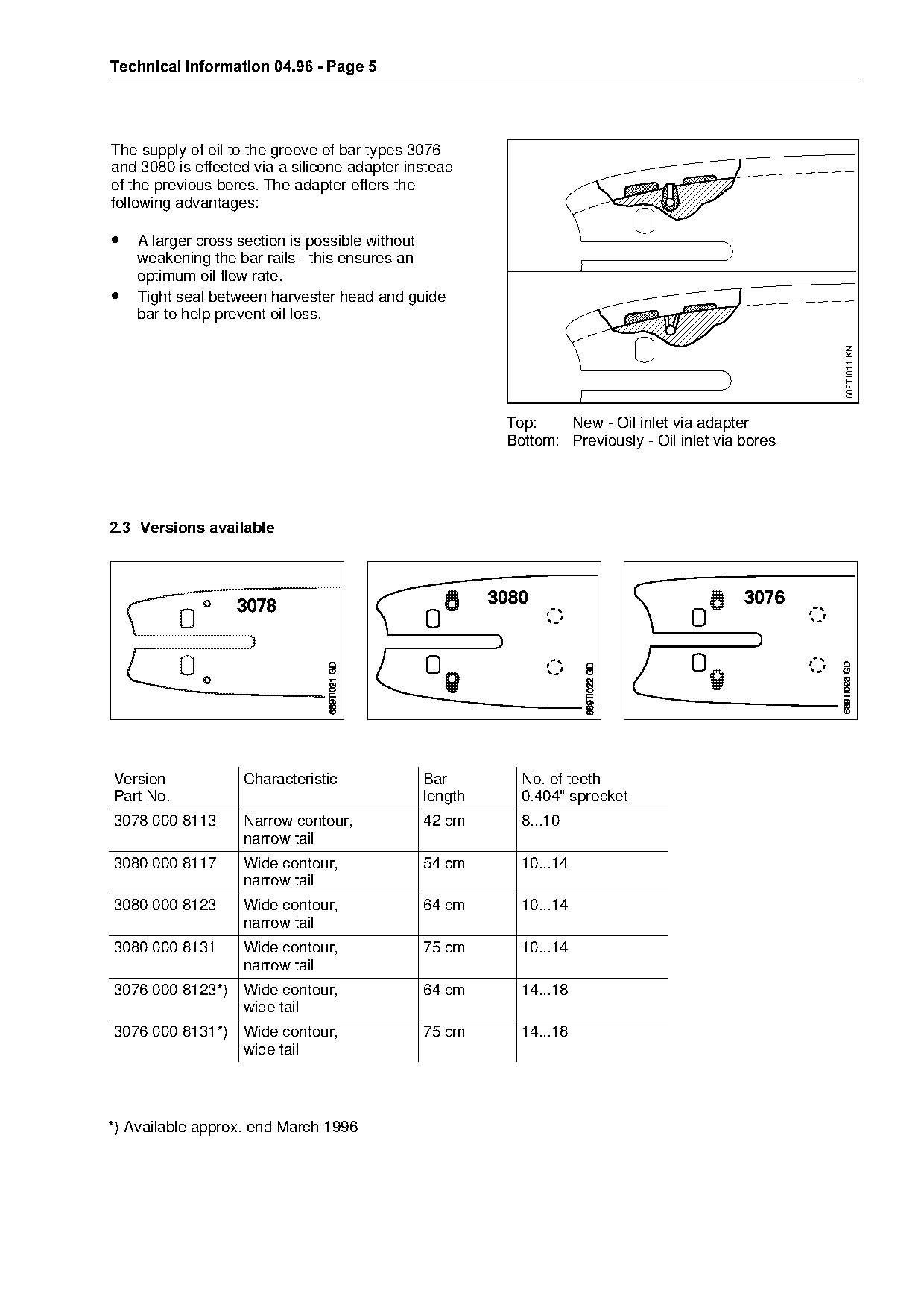
The supply of oil to the groove of bar types 3076
and 3080 is effected via a silicone adapter instead
of the previous bores. The adapter offers the
following advantages:

• A larger cross section is possible without
    weakening the bar rails - this ensures an
    optimum oil flow rate.
•   Tight seal between harvester head and guide
    bar to help prevent oil loss.

                                                                                                   689TI011 KN
                                                        Top:    New - Oil inlet via adapter

                                                        Bottom: Previously - Oil inlet via bores

2.3=Versions available

Version            Characteristic              Bar        No. of teeth
Part No.                                       length     0.404" sprocket

3078 000 8113      Narrow contour,             42 cm      8...10
                   narrow tail

3080 000 8117      Wide contour,               54 cm      10...14
                   narrow tail
3080 000 8123      Wide contour,               64 cm      10...14

                   narrow tail
3080 000 8131      Wide contour,               75 cm      10...14

                   narrow tail
3076 000 8123*)    Wide contour,               64 cm      14...18
                   wide tail
3076 000 8131*)    Wide contour,               75 cm      14...18
                   wide tail

*) Available approx. end March 1996
Page 6 of 6
Text of page 6 — search, copy, screen readers
Technical Information 04.96 - Page 6
2.4=Spare parts for guide bars
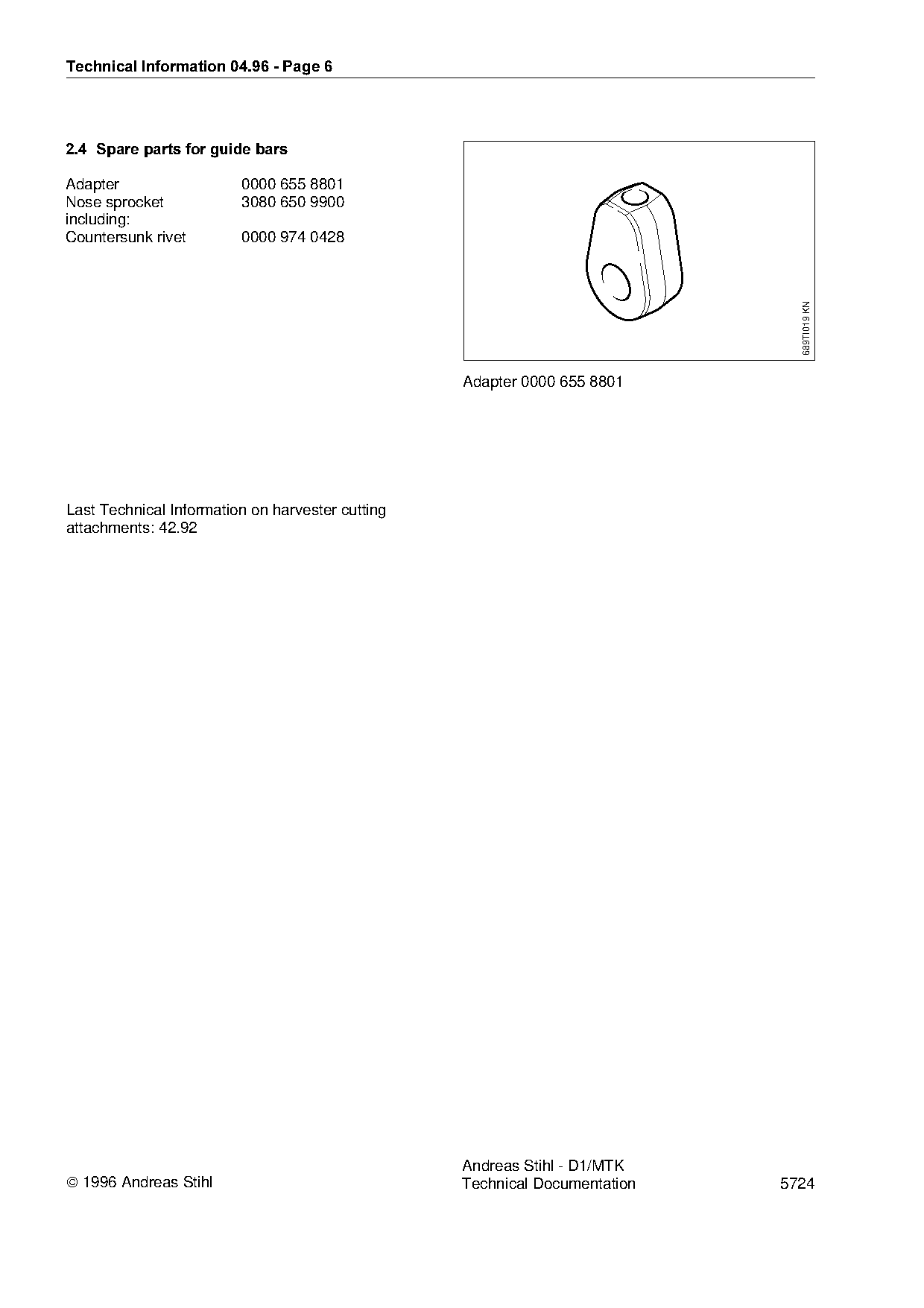
Adapter 0000 655 8801
Nose sprocket 3080 650 9900
including:
Countersunk rivet 0000 974 0428
689TI019 KN
Adapter 0000 655 8801
Last Technical Information on harvester cutting
attachments: 42.92
Andreas Stihl - D1/MTK
1996 Andreas Stihl Technical Documentation 5724 Most of these PDFs embed fonts with a shifted character map, so the text above was recovered rather than copied — read it as a faithful but imperfect transcription, and treat the page image above each block as the authority where the two disagree — the figures exist only there, because they are vector drawings that text extraction cannot keep.