Technical Information · issue 39 of 1996
Chains: STIHL Oilomatic system with oil reservoir
Accessory changes & notes
Source-reviewed accessory relationships. These notes do not establish fitment to unnamed saw models. Availability statements belong to the bulletin’s date.
Service note · Accessory
Oilomatic oil reservoir: filling, transport and release at the bar nose
Three lubrication phases: Ematic filling, transport and release; bar rails, chain joints and Duromatic nose benefit claims.
- Some Oilomatic chains gain a computer-designed BORE in EACH DRIVE LINK in addition to the existing oil channel. The reservoir is not a replacement for the channel. Section 1 says the developed channel-and-reservoir system had been patented for STIHL; that is a 1996 source statement, not a finding about present patent status.
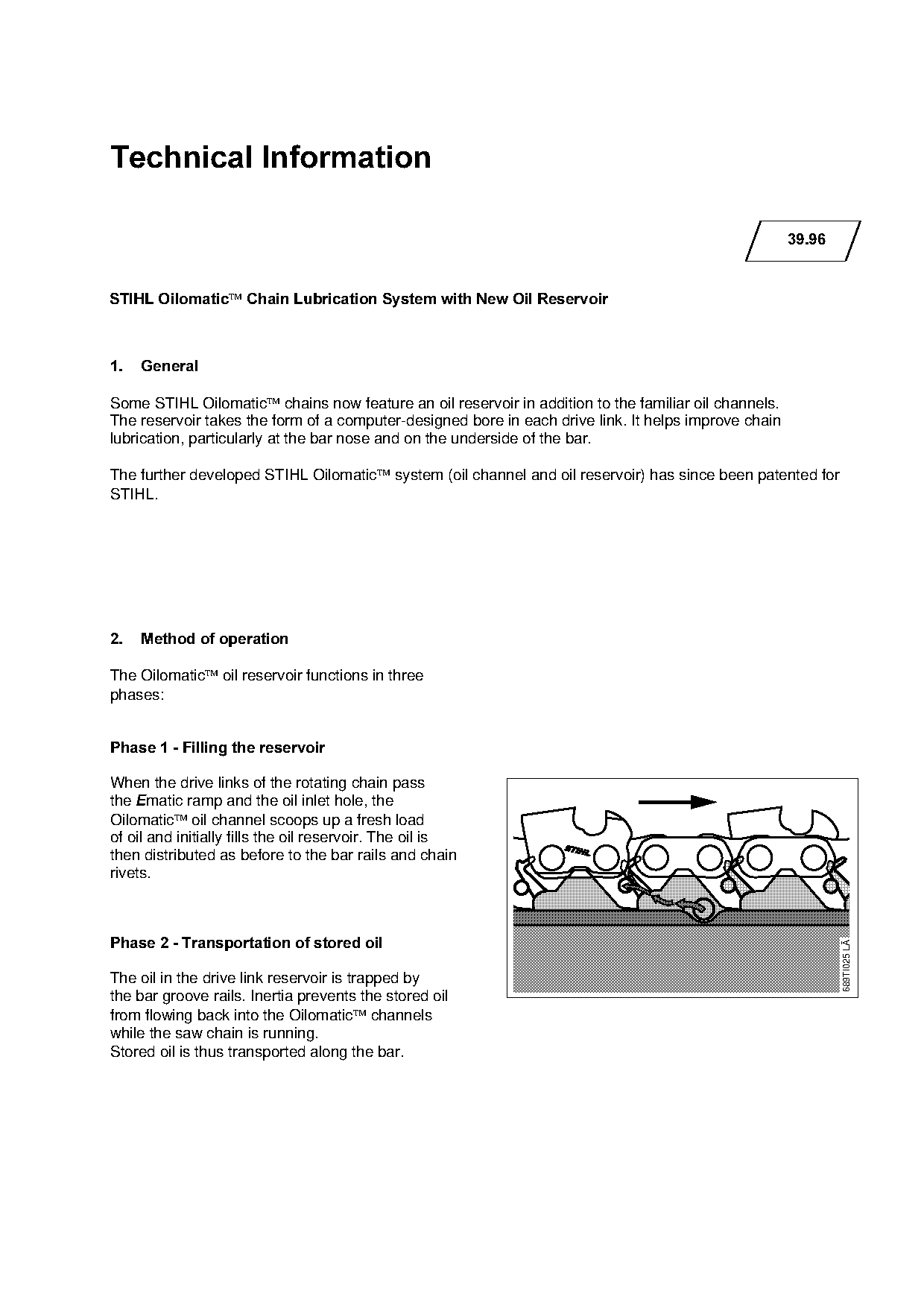
- Phase 1: when rotating drive links pass the Ematic ramp and oil inlet hole, the Oilomatic channel scoops up oil and INITIALLY fills the reservoir. Oil is then distributed as before to the bar rails and chain rivets. The page 1 drawing shows direction of chain travel and the oil-inlet region; it supplies no flow rate or bore dimensions.
- Phase 2: bar groove rails trap the oil in the drive-link reservoir. The TI attributes retention while the chain runs to inertia preventing flow back into the channels; stored oil is transported along the bar. This description is not a stationary leak-tightness claim.
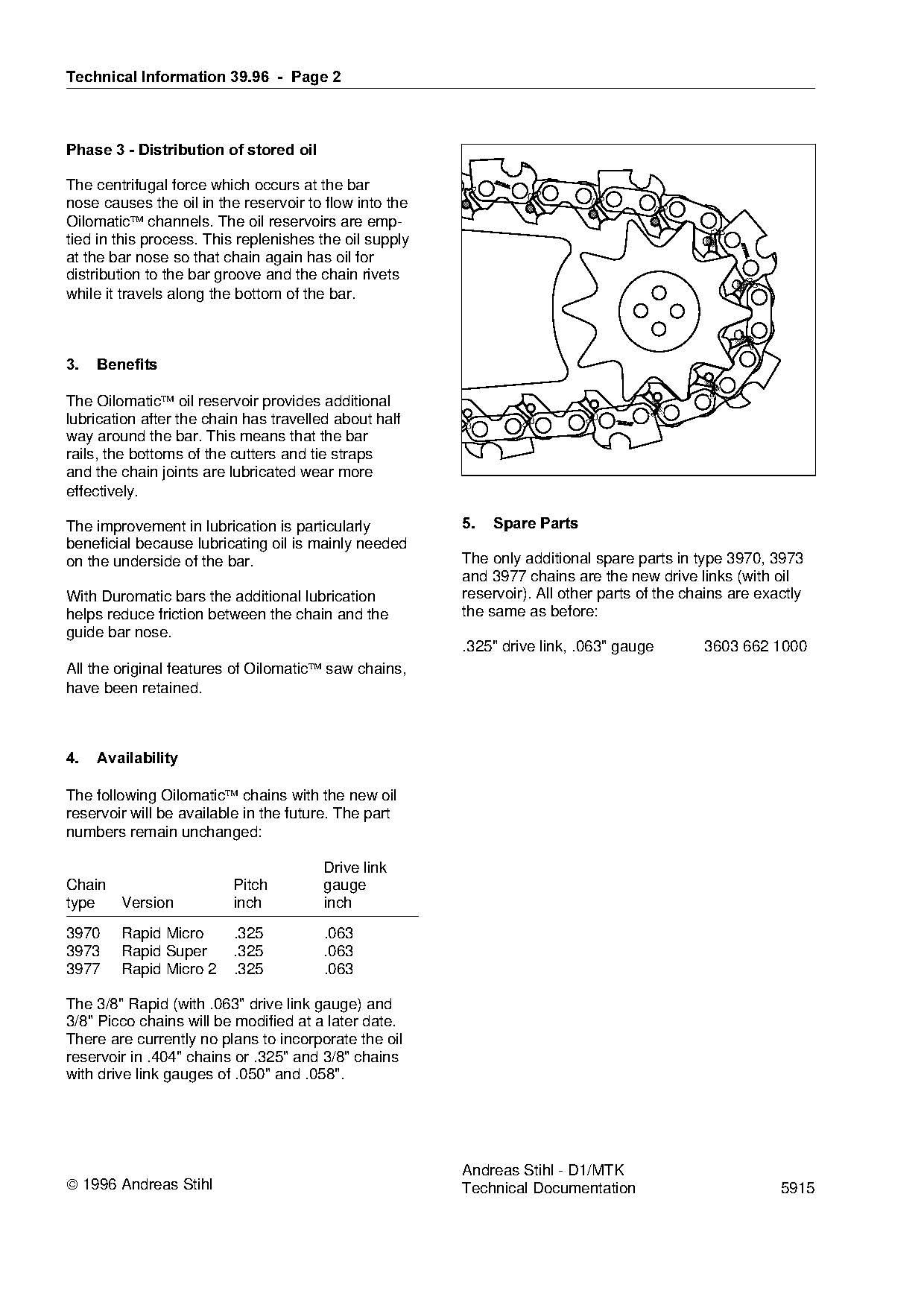
- Phase 3: centrifugal force at the bar nose releases stored oil into the Oilomatic channels, EMPTYING the reservoirs. This replenishes oil at the nose and for distribution to the groove and rivets along the BOTTOM of the bar. The page 2 nose drawing illustrates this phase; it does not limit all benefit claims to sprocket-nose bars.
- Section 3 claims more effective lubrication of bar rails, bottoms of cutters and tie straps, and chain joints after about HALF a circuit. It says oil is mainly needed underneath the bar, and specifically claims reduced chain/nose friction with DUROMATIC bars. Original Oilomatic features are retained. These are qualitative source claims, not measured gains or permission to reduce oil supply. The printed phrase "are lubricated wear more effectively" is grammatically defective; no numeric wear reduction is derived.
- Historical TI39/1996 chain-accessory evidence, not current availability or saw-model/bar fitment. No serial cutoff, chain-loop length or verified physical interchange is established. No hardware operation was performed.
Source: TI 39/1996, p. 1 · TI 39/1996, p. 2 — Oilomatic oil reservoir: filling, transport and release at the bar nose.
No additional parts-table entry added.
Service note · Accessory
Oilomatic reservoir chains: 3970, 3973 and 3977 availability in 1996
Rapid Micro, Rapid Super and Rapid Micro 2: .325-inch pitch, .063-inch gauge; later 3/8 Rapid/Picco plans and .404/.050/.058 exclusions remain dated.
- Section 4 lists chain TYPE 3970 Rapid Micro, TYPE 3973 Rapid Super and TYPE 3977 Rapid Micro 2. EACH row specifies .325-inch PITCH and .063-inch DRIVE-LINK GAUGE. These four-digit types are not complete ordering numbers, loop lengths or drive-link counts.
- The three listed chains with oil reservoirs WILL BE AVAILABLE IN THE FUTURE, with chain part numbers UNCHANGED. Section 1 meanwhile says SOME chains now feature the reservoir. Retain both statements as printed rather than inventing a common launch date, universal existing-stock identity or serial changeover.
- The 3/8-inch RAPID with .063-inch drive-link gauge and the 3/8-inch PICCO chains are to be modified AT A LATER DATE. The Picco clause specifies no gauge. These future plans are not evidence that the changes had already occurred or that the .325-inch spare drive link fits them.
- There were CURRENTLY NO PLANS in this 1996 TI for oil reservoirs in .404-inch chains, or .325-inch and 3/8-inch chains with .050-inch or .058-inch drive-link gauges. This is a dated product-plan statement, not a permanent prohibition, a later-chain inventory, or a claim that those chains lacked all Oilomatic channels.
- Historical TI39/1996 chain-accessory evidence, not current availability or saw-model/bar fitment. No serial cutoff, chain-loop length or verified physical interchange is established. No hardware operation was performed.
Source: TI 39/1996, p. 1 · TI 39/1996, p. 2 — Oilomatic reservoir chains: 3970, 3973 and 3977 availability in 1996.
No additional parts-table entry added.
Service note · Accessory
Oilomatic 3970 / 3973 / 3977: reservoir drive link 3603 662 1000
New .325-inch-pitch, .063-inch-gauge drive link; all other parts unchanged in the three listed chain types.
- Section 5 identifies the ONLY ADDITIONAL spare parts in chain types 3970, 3973 and 3977 as the new DRIVE LINKS WITH OIL RESERVOIR. The listed component is 3603 662 1000, .325-inch pitch and .063-inch drive-link gauge. It is a drive link, NOT a complete chain loop.
- All OTHER parts of those chains are said to be exactly the same as before. This is not a statement that every component is interchangeable across Rapid Micro, Rapid Super and Rapid Micro 2, nor a mix-and-match repair procedure.
- UNCHANGED CHAIN part numbers in section 4 and the NEW DRIVE-LINK spare part in section 5 describe different objects. No previous drive-link number or explicit old-to-new supersession pair is printed, so none is manufactured. The 3603 prefix does not broaden the three listed chain-type assignments.
- The drawing provides no link-installation sequence, rivet specification or repair-tool assignment. No complete chain repair procedure or compatibility with the separately planned 3/8-inch Rapid/Picco modifications is inferred.
- Historical TI39/1996 chain-accessory evidence, not current availability or saw-model/bar fitment. No serial cutoff, chain-loop length or verified physical interchange is established. No hardware operation was performed.
Source: TI 39/1996, p. 2 — Oilomatic 3970 / 3973 / 3977: reservoir drive link 3603 662 1000.
Part numbers (1)
- 3603 662 1000 — Drive link with oil reservoir; .325-inch pitch, .063-inch gaugeNew spare drive link, not complete chain · TI39/1996 chain types 3970 Rapid Micro, 3973 Rapid Super and 3977 Rapid Micro 2 only
Full text
Page 1 of 2
Text of page 1 — search, copy, screen readers
Technical Information
39.96
STIHL Oilomatic Chain Lubrication System with New Oil Reservoir
1.===General
Some STIHL Oilomatic chains now feature an oil reservoir in addition to the familiar oil channels.
The reservoir takes the form of a computer-designed bore in each drive link. It helps improve chain
lubrication, particularly at the bar nose and on the underside of the bar.
The further developed STIHL Oilomatic system (oil channel and oil reservoir) has since been patented for
STIHL.
2.===Method of operation
The Oilomatic oil reservoir functions in three
phases:
Phase 1 - Filling the reservoir
When the drive links of the rotating chain pass
the (matic ramp and the oil inlet hole, the
Oilomatic oil channel scoops up a fresh load
of oil and initially fills the oil reservoir. The oil is
then distributed as before to the bar rails and chain
rivets.
Phase 2 - Transportation of stored oil
689TI025 LÄ
The oil in the drive link reservoir is trapped by
the bar groove rails. Inertia prevents the stored oil
from flowing back into the Oilomatic channels
while the saw chain is running.
Stored oil is thus transported along the bar. Page 2 of 2
Text of page 2 — search, copy, screen readers
Technical Information 39.96 - Page 2
Phase 3 - Distribution of stored oil
The centrifugal force which occurs at the bar
nose causes the oil in the reservoir to flow into the
Oilomatic channels. The oil reservoirs are emp-
tied in this process. This replenishes the oil supply
at the bar nose so that chain again has oil for
distribution to the bar groove and the chain rivets
while it travels along the bottom of the bar.
3.===Benefits
The Oilomatic oil reservoir provides additional
lubrication after the chain has travelled about half
way around the bar. This means that the bar
rails, the bottoms of the cutters and tie straps
and the chain joints are lubricated wear more
effectively.
The improvement in lubrication is particularly 5.===Spare Parts
beneficial because lubricating oil is mainly needed
on the underside of the bar.
The only additional spare parts in type 3970, 3973
and 3977 chains are the new drive links (with oil
reservoir). All other parts of the chains are exactly
With Duromatic bars the additional lubrication
helps reduce friction between the chain and the the same as before:
guide bar nose.
.325" drive link, .063" gauge 3603 662 1000
All the original features of Oilomatic saw chains,
have been retained.
4.===Availability
The following Oilomatic chains with the new oil
reservoir will be available in the future. The part
numbers remain unchanged:
Drive link
Chain Pitch gauge
type Version inch inch
3970 Rapid Micro .325 .063
3973 Rapid Super .325 .063
3977 Rapid Micro 2 .325 .063
The 3/8" Rapid (with .063" drive link gauge) and
3/8" Picco chains will be modified at a later date.
There are currently no plans to incorporate the oil
reservoir in .404" chains or .325" and 3/8" chains
with drive link gauges of .050" and .058".
Andreas Stihl - D1/MTK
1996 Andreas Stihl Technical Documentation 5915 Most of these PDFs embed fonts with a shifted character map, so the text above was recovered rather than copied — read it as a faithful but imperfect transcription, and treat the page image above each block as the authority where the two disagree — the figures exist only there, because they are vector drawings that text extraction cannot keep.