Technical Information · issue 2 of 1997
New Electric Chainsaws E140, E160, E180 C
IssueTI 2/1997
Full text
Page 1 of 4
Text of page 1 — search, copy, screen readers
Technical Information

                                                                                             02.97

New Model E 140, E 160, E 180 C Electric Chainsaws

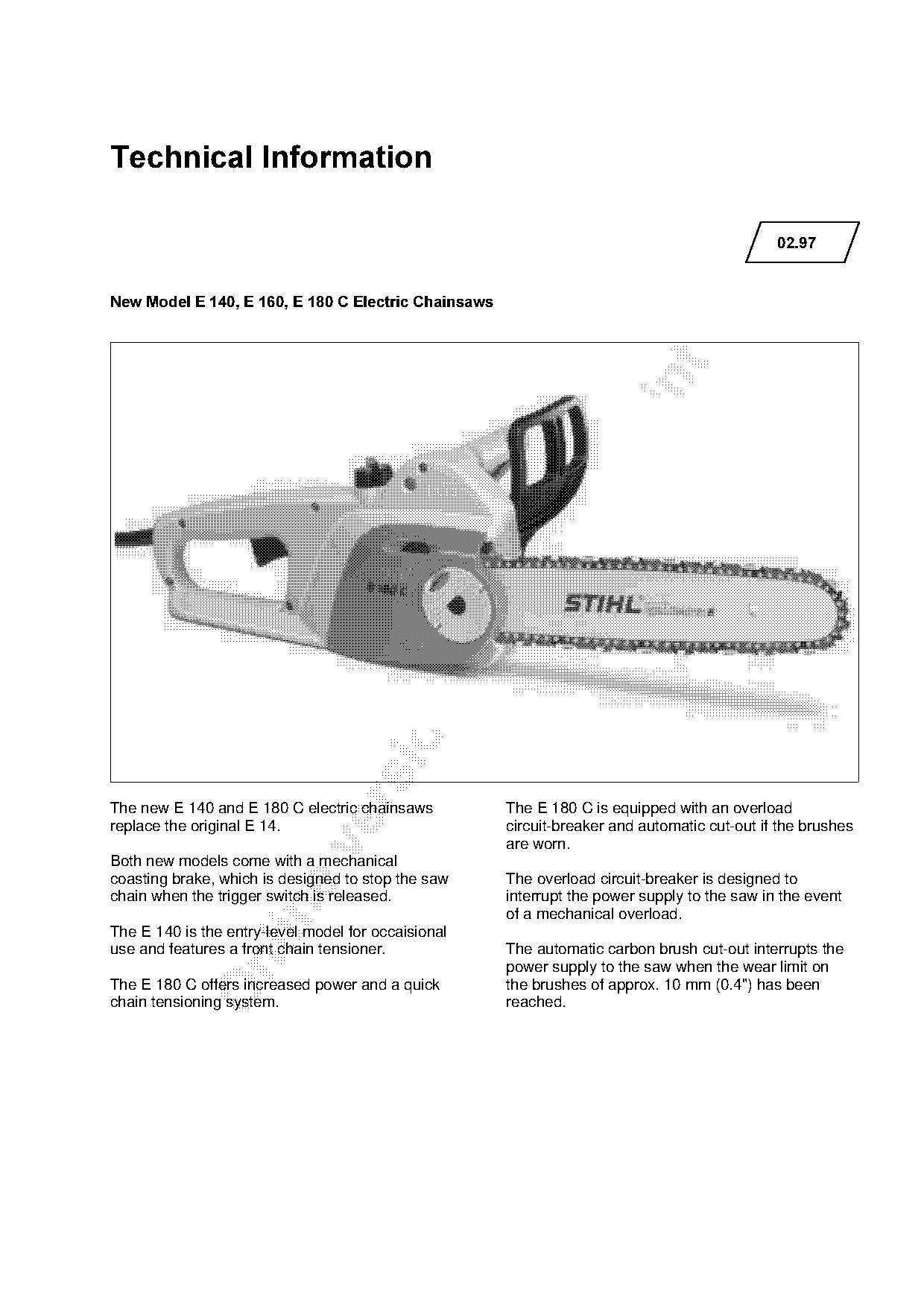
The new E 140 and E 180 C electric chainsaws         The E 180 C is equipped with an overload
replace the original E 14.                           circuit-breaker and automatic cut-out if the brushes
                                                     are worn.

Both new models come with a mechanical
coasting brake, which is designed to stop the saw    The overload circuit-breaker is designed to
chain when the trigger switch is released.           interrupt the power supply to the saw in the event

                                                     of a mechanical overload.
The E 140 is the entry-level model for occaisional
use and features a front chain tensioner.            The automatic carbon brush cut-out interrupts the

                                                     power supply to the saw when the wear limit on
The E 180 C offers increased power and a quick       the brushes of approx. 10 mm (0.4") has been
chain tensioning system.                             reached.
Page 2 of 4
Text of page 2 — search, copy, screen readers
Technical Information 02.97  -  Page 2

&RQWHQWV

1.   Technical Description
2.   Repairs
3.   Specifications
4.   Cutting Attachment

1.=Technical Description

1.1=Drive


                                           1
                                                                      5
                                                                          100TI002 KN
                                                4

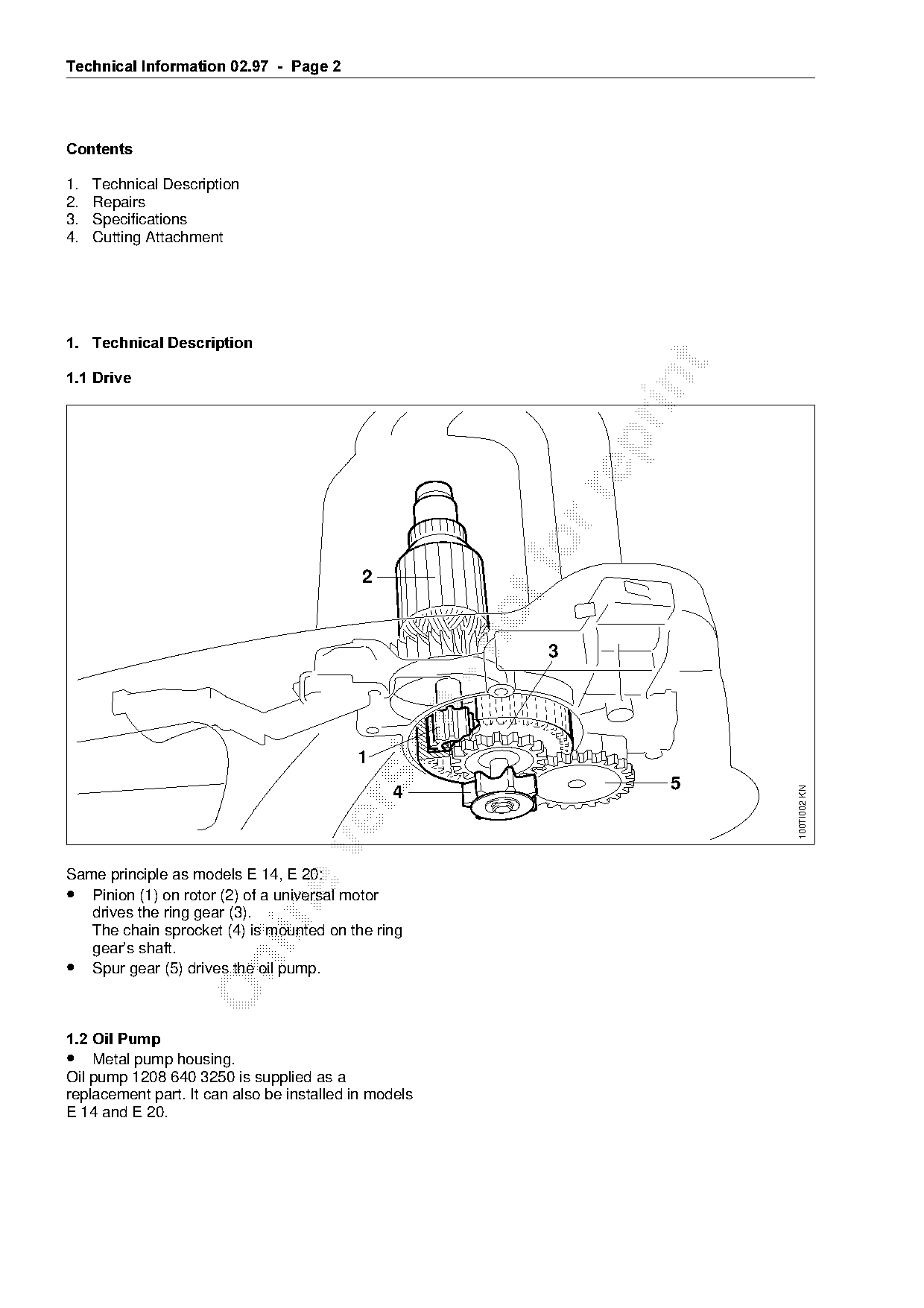
Same principle as models E 14, E 20:
• Pinion (1) on rotor (2) of a universal motor

   drives the ring gear (3).
   The chain sprocket (4) is mounted on the ring
   gear’s shaft.
• Spur gear (5) drives the oil pump.

1.2=Oil Pump
• Metal pump housing.
Oil pump 1208 640 3250 is supplied as a
replacement part. It can also be installed in models
E 14 and E 20.
Page 3 of 4
Text of page 3 — search, copy, screen readers
Technical Information 02.97  -  Page 3

1.3=Chain braking system
                                                           2            3
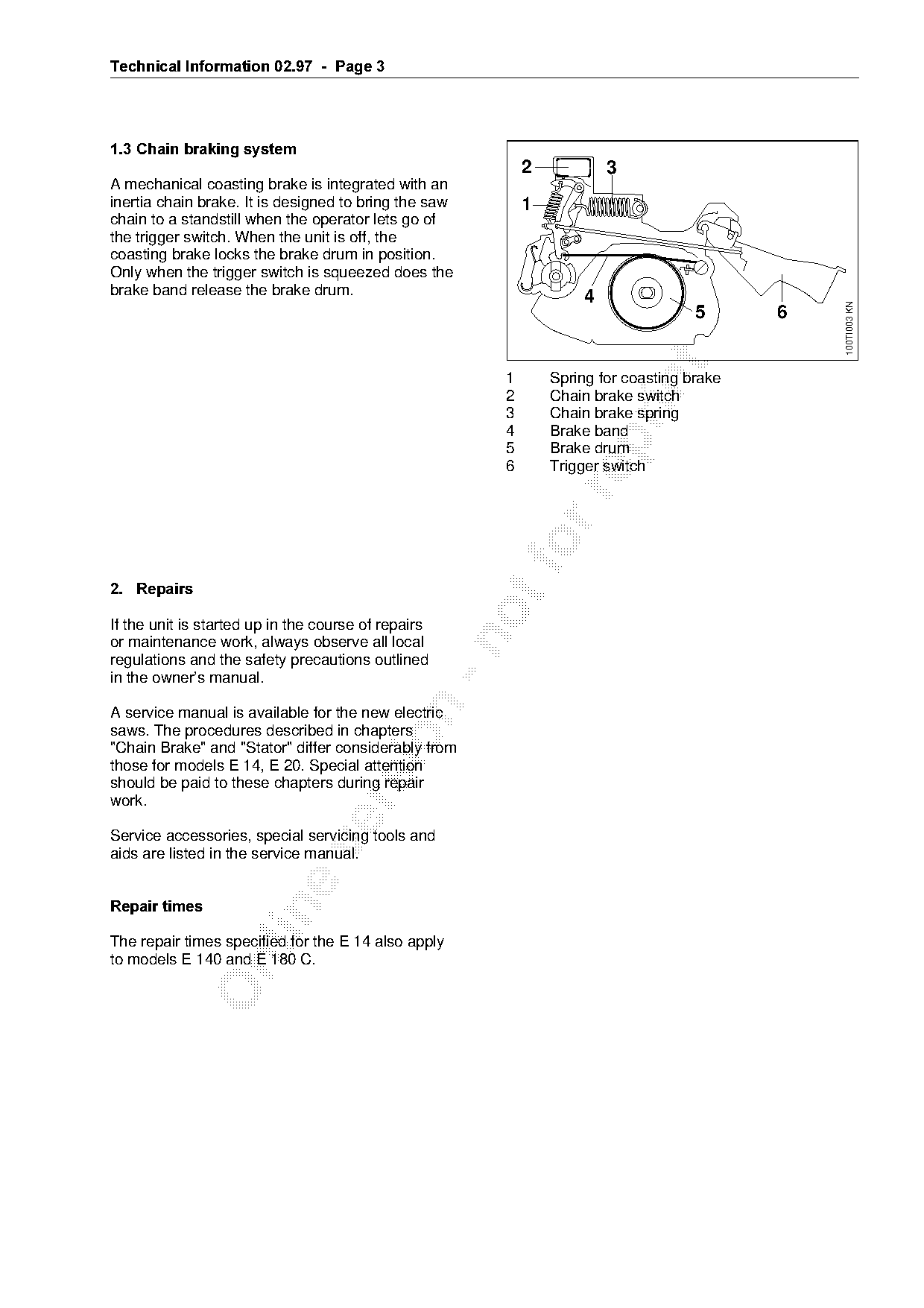
A mechanical coasting brake is integrated with an
inertia chain brake. It is designed to bring the saw       1
chain to a standstill when the operator lets go of
the trigger switch. When the unit is off, the
coasting brake locks the brake drum in position.
Only when the trigger switch is squeezed does the
brake band release the brake drum.
                                                                    4

                                                                                               100TI003 KN
                                                                                    5      6

                                                       1       Spring for coasting brake

                                                       2       Chain brake switch
                                                       3       Chain brake spring
                                                       4       Brake band

                                                       5       Brake drum
                                                       6       Trigger switch

2.=Repairs

If the unit is started up in the course of repairs

or maintenance work, always observe all local
regulations and the safety precautions outlined
in the owner’s manual.

A service manual is available for the new electric
saws. The procedures described in chapters

"Chain Brake" and "Stator" differ considerably from
those for models E 14, E 20. Special attention
should be paid to these chapters during repair
work.

Service accessories, special servicing tools and

aids are listed in the service manual.

Repair times

The repair times specified for the E 14 also apply
to models E 140 and E 180 C.
Page 4 of 4
Text of page 4 — search, copy, screen readers
Technical Information 02.97 - Page 4
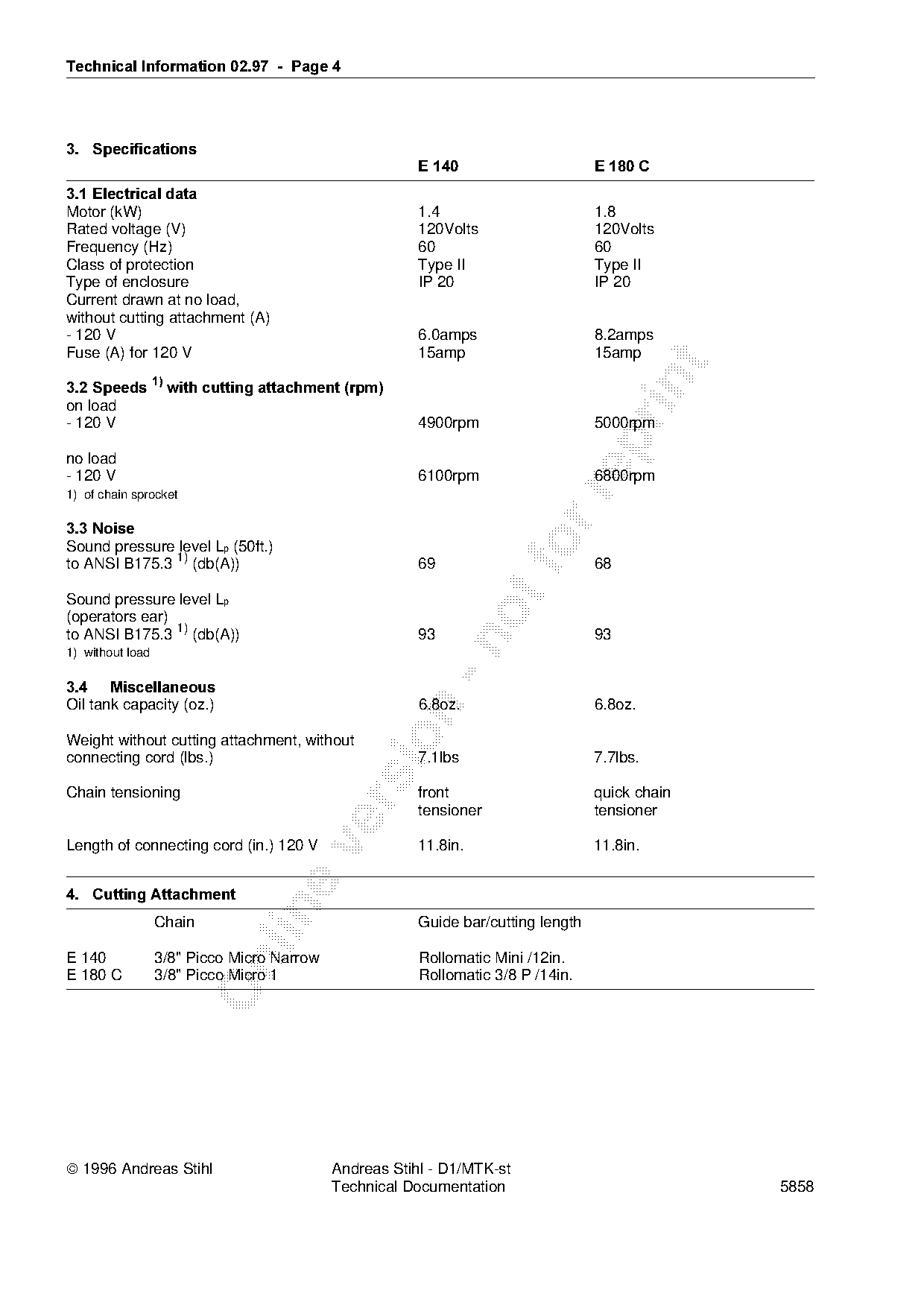
3.=Specifications
E 140======================E 180 C
3.1=Electrical data
Motor (kW) 1.4 1.8
Rated voltage (V) 120Volts 120Volts
Frequency (Hz) 60 60
Class of protection Type II Type II
Type of enclosure IP 20 IP 20
Current drawn at no load,
without cutting attachment (A)
- 120 V 6.0amps 8.2amps
Fuse (A) for 120 V 15amp 15amp
3.2=Speeds 1= with cutting attachment =rpm
on load
- 120 V 4900rpm 5000rpm
no load
- 120 V 6100rpm 6800rpm
1) of chain sprocket
3.3=Noise
Sound pressure level Lp (50ft.)
to ANSI B175.3 1) (db(A)) 69
fo 68
Sound pressure level Lp
(operators ear)
to ANSI B175.3 1) (db(A)) 93 93
1) without load
3.4=Miscellaneous
Oil tank capacity (oz.) 6.8oz. 6.8oz.
Weight without cutting attachment, without
connecting cord (lbs.) 7.1lbs 7.7lbs.
Chain tensioning front quick chain
tensioner tensioner
Length of connecting cord (in.) 120 V 11.8in. 11.8in.
4.=Cutting Attachment
Chain Guide bar/cutting length
E 140 3/8" Picco Micro Narrow Rollomatic Mini /12in.
E 180 C 3/8" Picco Micro 1 Rollomatic 3/8 P /14in.
1996 Andreas Stihl Andreas Stihl - D1/MTK-st
Technical Documentation 5858 Most of these PDFs embed fonts with a shifted character map, so the text above was recovered rather than copied — read it as a faithful but imperfect transcription, and treat the page image above each block as the authority where the two disagree — the figures exist only there, because they are vector drawings that text extraction cannot keep.