Technical Information · issue 17 of 1998
TS General: Sales and Service Instructions for STI
Historical service guidance
General historical servicing reference, not an exact-model repair procedure or proof of compatibility. Follow the model-specific manual and preserve the source date and limits.
Service note · General servicing
TS cutting-off machines: EU wheel rating and spindle-speed distinction
EU-only TI17/1998: 100 m/s wheel limit, rated load speed versus maximum no-load speed, and the printed up-to-10% distinction.
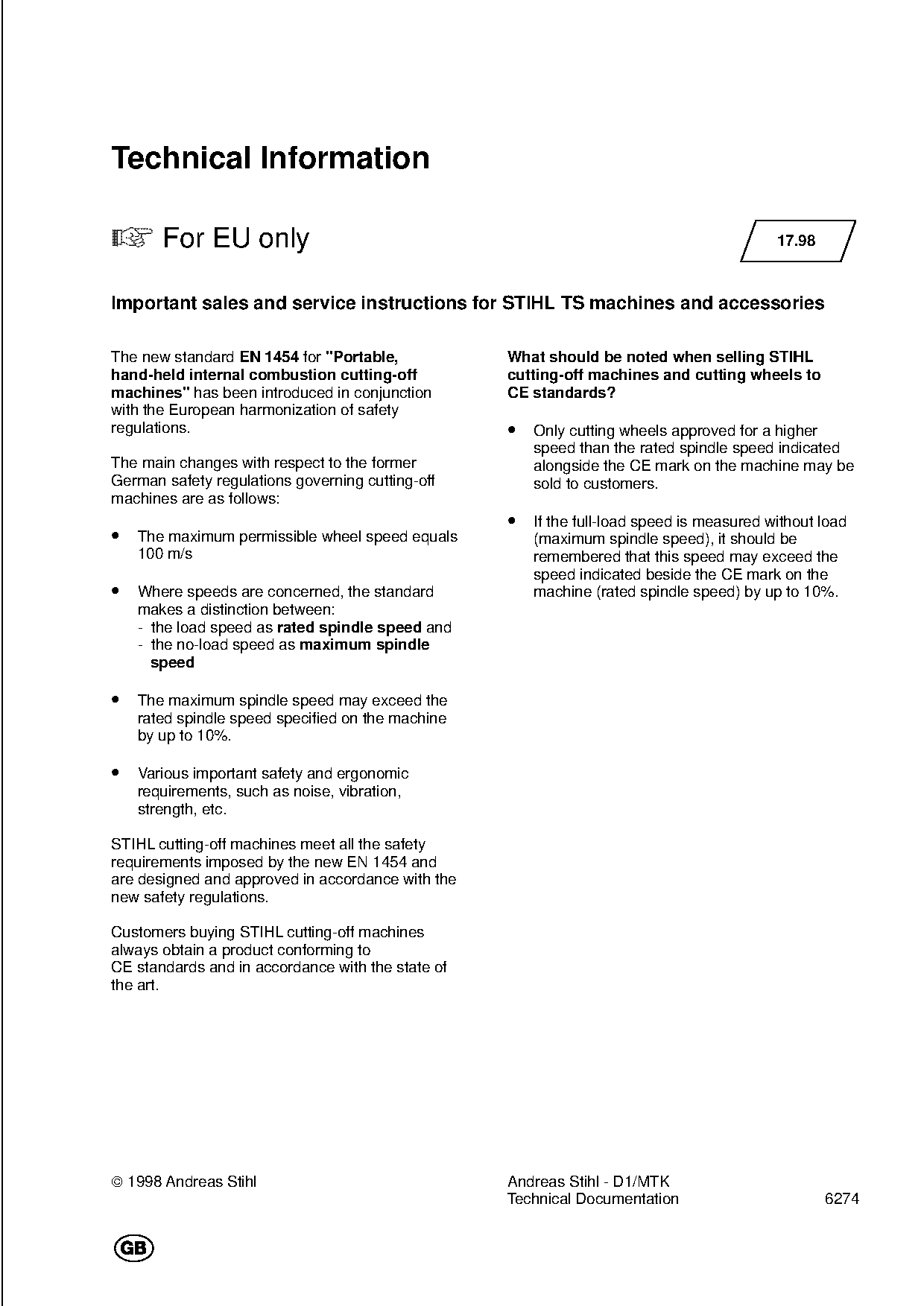
- The complete bulletin is marked FOR EU ONLY. It describes the then-new EN 1454 for portable, hand-held internal combustion cutting-off machines, introduced with European harmonization of safety regulations; its comparison is with former German safety regulations. This is historical 1998 source context, not a determination of current EU law, current standards or worldwide applicability.
- The source gives maximum permissible WHEEL SPEED as 100 m/s. This linear wheel-speed limit is not a spindle speed in rpm. No wheel diameter, conversion to rpm, specific wheel part number or model-specific permissible combination is printed or inferred.
- The standard distinguishes LOAD SPEED as RATED SPINDLE SPEED and NO-LOAD SPEED as MAXIMUM SPINDLE SPEED. The maximum spindle speed may exceed the rated spindle speed specified on the machine by UP TO 10%. This is a distinction between conditions, not an instruction to increase an engine setting by 10%.
- When selling machines and cutting wheels to CE standards, the notice says ONLY wheels approved for a HIGHER SPEED THAN the rated spindle speed indicated alongside the CE mark on the machine may be sold. Preserve the strict higher-than wording; do not silently change it to equal-to-or-greater or select a wheel from the 100 m/s statement alone.
- The second sales/service bullet literally says: If the full-load speed is measured without load (maximum spindle speed), remember it may exceed the speed beside the CE mark (rated spindle speed) by up to 10%. Its full-load/without-load phrasing is retained as printed, alongside the explicit load/no-load definitions above; no tachometer method, carburetor setting or operational test is supplied.
- The remaining requirements name noise, vibration, strength and other safety/ergonomic concerns. The statements that STIHL cutting-off machines meet EN 1454 and buyers receive CE-conforming state-of-the-art products are the manufacturer’s 1998 assertions, not independent certification or a current condition assessment of a used machine. Footer: copyright 1998, D1/MTK, documentation 6274 and GB language mark.
- No exact TS model list, serial cutoff, wheel fitment table or replacement part is present. This general service reference stays on the original bulletin rather than being assigned to every catalog TS model.
- Historical source guidance only; no present-day stock or conformity guarantee and no verified physical interchange. No hardware operation was performed.
Source: TI 17/1998, p. 1 — Complete single page: EU-only heading, both columns, every speed/standards bullet, manufacturer assertions and footer.
No additional parts-table entry added.
Full text
Page 1 of 1
Text of page 1 — search, copy, screen readers
Technical Information
☞ For EU only 17.98
Important sales and service instructions for STIHL TS machines and accessories
The new standard EN 1454 for "Portable, What should be noted when selling STIHL
hand-held internal combustion cutting-off cutting-off machines and cutting wheels to
machines" has been introduced in conjunction CE standards?
with the European harmonization of safety
regulations. • Only cutting wheels approved for a higher
speed than the rated spindle speed indicated
The main changes with respect to the former alongside the CE mark on the machine may be
German safety regulations governing cutting-off sold to customers.
machines are as follows:
• If the full-load speed is measured without load
• The maximum permissible wheel speed equals
100 m/s fo
(maximum spindle speed), it should be
remembered that this speed may exceed the
speed indicated beside the CE mark on the
• Where speeds are concerned, the standard machine (rated spindle speed) by up to 10%.
makes a distinction between:
- the load speed as rated spindle speed and
- the no-load speed as maximum spindle
speed
• The maximum spindle speed may exceed the
rated spindle speed specified on the machine
by up to 10%.
• Various important safety and ergonomic
requirements, such as noise, vibration,
strength, etc.
STIHL cutting-off machines meet all the safety
requirements imposed by the new EN 1454 and
are designed and approved in accordance with the
new safety regulations.
Customers buying STIHL cutting-off machines
always obtain a product conforming to
CE standards and in accordance with the state of
the art.
1998 Andreas Stihl Andreas Stihl - D1/MTK
Technical Documentation 6274 Most of these PDFs embed fonts with a shifted character map, so the text above was recovered rather than copied — read it as a faithful but imperfect transcription, and treat the page image above each block as the authority where the two disagree — the figures exist only there, because they are vector drawings that text extraction cannot keep.