Technical Information · issue 21 of 1998
General: Machine Numbering
Historical service guidance
General historical servicing reference, not an exact-model repair procedure or proof of compatibility. Follow the model-specific manual and preserve the source date and limits.
Service note · General servicing
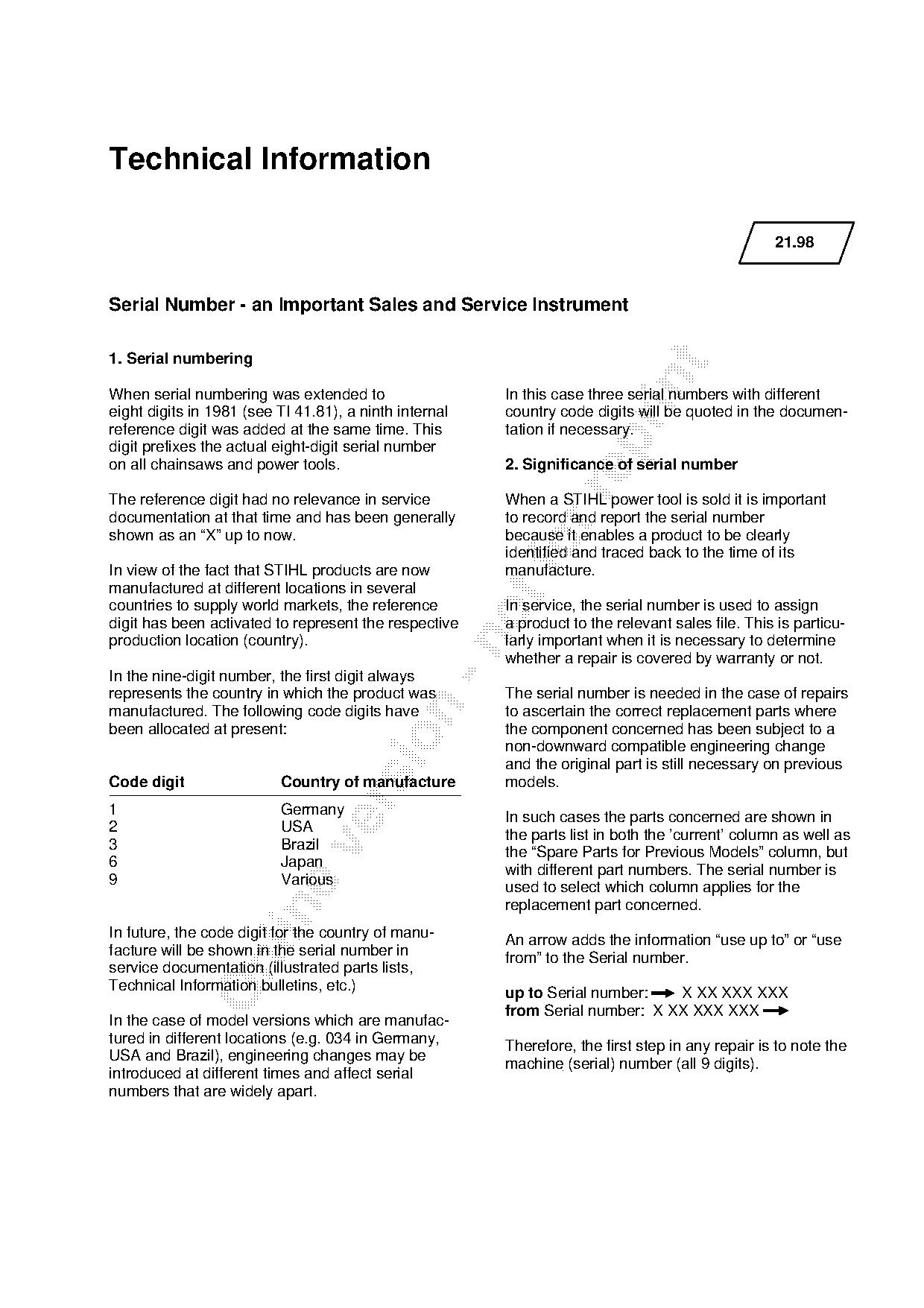
Serial numbers: nine digits and historical country prefixes
TI21/1998 activates the leading digit for production country; changes may have different country-specific numbers.
- Section 1 says the actual serial number was extended to EIGHT DIGITS in 1981 (historical reference TI41.81). A NINTH internal reference digit was added at the same time, PREFIXING the eight digits on chainsaws and power tools. This prefix previously had no service-documentation relevance and was generally printed as X. X is a placeholder in that historical documentation, not a country code or a digit to discard from a real machine number.
- The bulletin activates the FIRST digit of the NINE-DIGIT number to represent the country of manufacture. Its table says codes allocated AT PRESENT: 1 = Germany; 2 = USA; 3 = Brazil; 6 = Japan; 9 = Various. Do not infer meanings for unlisted digits, an exact factory from Various, sales destination, or a current worldwide code table.
- Future service documentation, including IPLs and TIs, is to show the country digit. For model versions made in different locations, changes can occur at DIFFERENT TIMES and at serial numbers WIDELY APART. The explicit example is 034 manufactured in Germany, USA and Brazil; THREE separate serial numbers with different country prefixes may be quoted if necessary. This is not a three-country production claim for every model.
- This note does not convert the first digit into a year code, infer a manufacture date from the remaining eight digits, or merge country-specific changes into one numeric range. TI41.81 is cited as numbering history; the retained TI21/1998 statement is self-contained and does not establish the complete contents of that earlier bulletin.
- Historical 1998 source guidance, not a present-day serial decoder, parts-fitment determination or physical inspection. No hardware operation was performed.
Source: TI 21/1998, p. 1 — Page 1 entire section 1, continuation at top right and all five country-code table rows.
No additional parts-table entry added.
Service note · General servicing
Serial numbers: selecting current versus previous-model parts
Record all nine digits; up-to and from arrows qualify a particular changed component, not an entire machine.
- Section 2 requires the serial number to be recorded and reported when a power tool is sold, so the product can be identified and traced to its manufacture. In servicing it connects the product to its sales file, particularly for deciding whether a repair falls under warranty. These are historical administrative purposes, not a warranty eligibility decision or an encoded-date algorithm.
- Where a component has undergone a NON-DOWNWARD COMPATIBLE engineering change, the original part is still required for previous models. The IPL then shows different part numbers in the CURRENT and SPARE PARTS FOR PREVIOUS MODELS columns; use the machine serial to select the appropriate column FOR THAT COMPONENT. Do not turn this into a rule that all newer parts fit older machines, or that every part in a column shares one machine-wide boundary.
- The original figure prints the placeholder X XX XXX XXX. UP TO has a right-pointing arrow BEFORE the number; FROM has a right-pointing arrow AFTER the number. The arrow position and accompanying wording distinguish the two uses. These examples contain NO numeric cutoff: no invented threshold, off-by-one adjustment or automatic range matcher is added.
- The final sentence makes the first repair step noting the machine serial number, ALL 9 DIGITS. Read this together with section 1: country-specific changeovers may differ. The historical statement about traceability does not itself provide access to factory or sales records.
- Historical 1998 source guidance, not a present-day serial decoder, parts-fitment determination or physical inspection. No hardware operation was performed.
Source: TI 21/1998, p. 1 — Page 1 entire section 2, current/previous-model column discussion, both arrow diagrams and final nine-digit instruction.
No additional parts-table entry added.
Service note · 017 / 023 / 036 / E 160 / FS 65-4 / FS 85
Serial locations: 017, 023, 036, E 160, FS 65-4 and FS 85
Six example drawings on TI21/1998 page 2 identify the marking, with distinct product-family captions.
No exact-model IPL link: These are illustrated machine-identity markings, not identified replacement parts or an exact IPL assembly/position. Retain the named example models and original diagrams on the bulletin; no assembly binding or shared-series variant expansion is established.
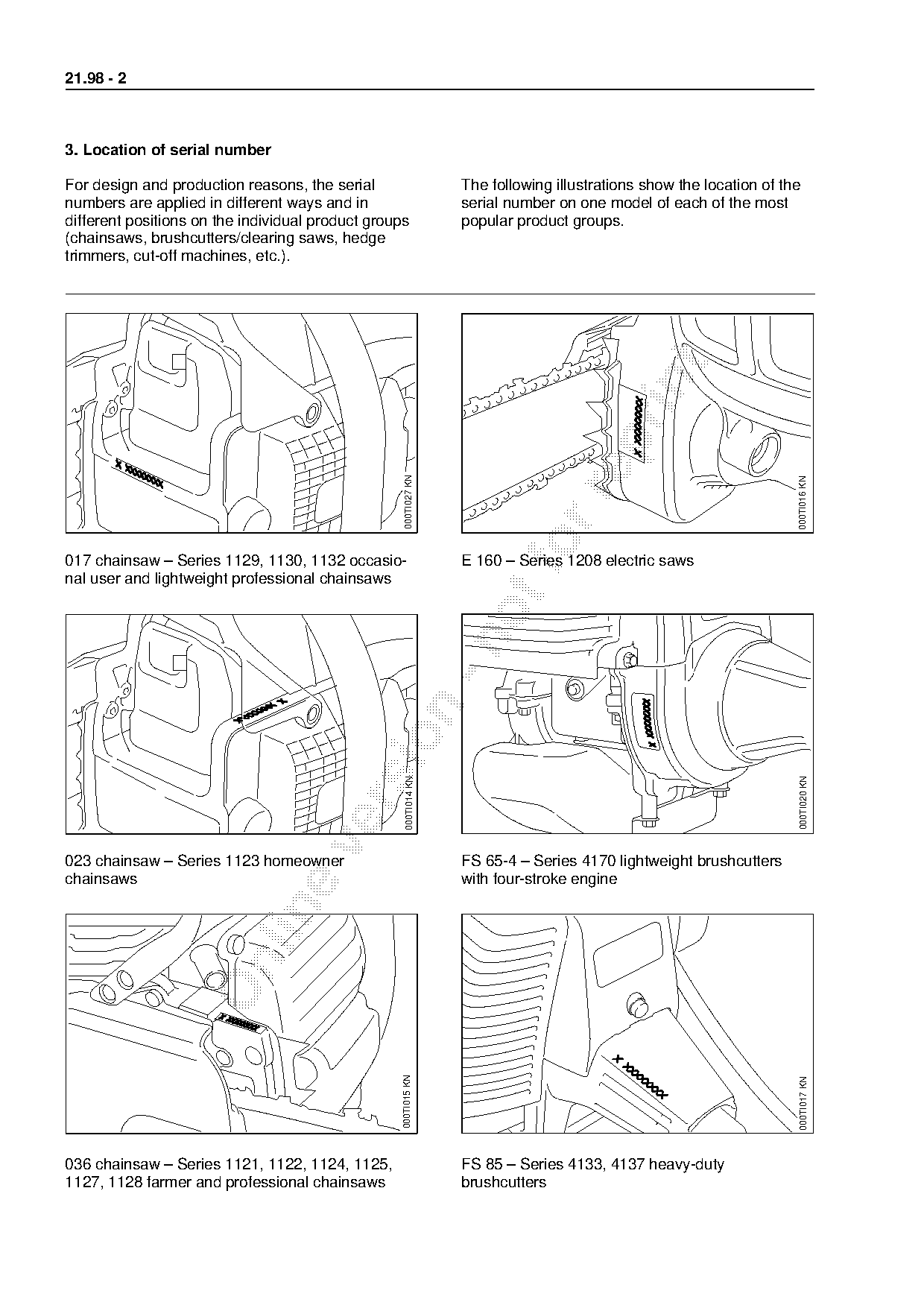
- Section 3 says serials are applied in DIFFERENT WAYS and POSITIONS for design and production reasons. Each illustration shows ONE MODEL representing a popular product group. Captioned series describe the group; they are not six alternative series identities for the single pictured model and do not prove identical marking placement on every variant.
- 017 chainsaw, figure 000TI027 KN (upper left): the X-marked strip is on the lower side ledge beneath the front-handle attachment in the pictured view. Caption: series 1129, 1130, 1132, occasional-user and lightweight professional chainsaws. This is the 017 illustration, not three separate variant drawings.
- 023 chainsaw, figure 000TI014 KN (middle left): marking on the upper ledge beside the front-handle attachment, above the vented area. Caption: series 1123 homeowner chainsaws. Do not substitute the different lower location in the adjacent 017 drawing.
- 036 chainsaw, figure 000TI015 KN (lower left): marking on the narrow upper crankcase ledge beside the front handle and outer cover. Caption: series 1121, 1122, 1124, 1125, 1127, 1128, farmer and professional chainsaws. Both 1127 and 1128 are printed in the original caption even though the extracted bulletin series metadata omits them; canonical source metadata is left unchanged.
- E 160, figure 000TI016 KN (upper right): vertical marking beside the guide-bar root on the pictured housing face. Caption: series 1208 electric saws. FS 65-4, figure 000TI020 KN (middle right): vertical strip on the housing beside the round cover. Caption: series 4170 lightweight brushcutters with FOUR-STROKE engine.
- FS 85, figure 000TI017 KN (lower right): marking on the inclined housing surface beside the drive-tube connection. Caption: series 4133, 4137 heavy-duty brushcutters. This does not assign FS 85 to every captioned series or extend the specific drawing to every FS variant.
- All six X-number markings are schematic placeholders, not real machine identifiers, replacement part numbers or serial changeovers. Use the linked original page for orientation; no stamped-versus-label material, removal procedure, viewing-side convention or exact dimension is inferred from the line drawings.
- Historical 1998 source guidance, not a present-day serial decoder, parts-fitment determination or physical inspection. No hardware operation was performed.
Source: TI 21/1998, p. 2 — Page 2 section 3 introduction and all six complete location drawings/captions.
No additional parts-table entry added.
Service note · FS 300 / FS 500 / HS 80 / BG 75 / BR 400 / TS 400
Serial locations: FS 300, FS 500, HS 80, BG 75, BR 400 and TS 400
Six further product-group examples on TI21/1998 page 3; source drawings control orientation.
No exact-model IPL link: These are illustrated machine-identity markings, not identified replacement parts or an exact IPL assembly/position. Retain the named example models and original diagrams on the bulletin; no assembly binding or shared-series variant expansion is established.
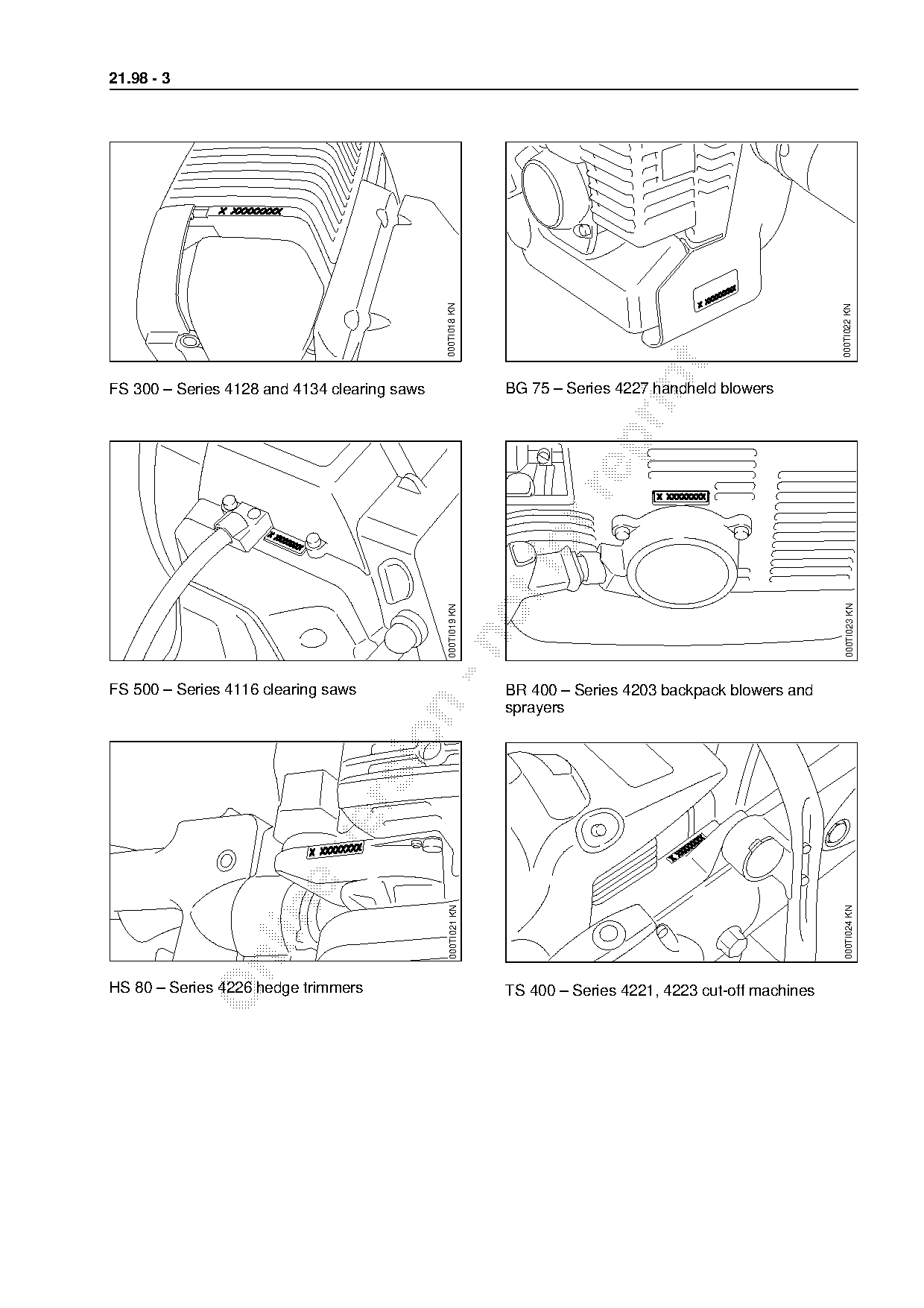
- Continuation of section 3: each drawing illustrates the NAMED EXAMPLE, not every model in its captioned series. Location descriptions below are visual locators in the printed view, not a disassembly procedure or replacement-assembly binding.
- FS 300, figure 000TI018 KN (upper left): horizontal marking on the ledge immediately below the vented housing. Caption: series 4128 and 4134 clearing saws. FS 500, figure 000TI019 KN (middle left): small marked rectangle beside the drive-tube connection. Caption: series 4116 clearing saws.
- HS 80, figure 000TI021 KN (lower left): horizontal marking on the housing beside the handle and below the vented section. Caption: series 4226 hedge trimmers. The nearby handle and fasteners locate the drawing; they are not marked serial-bearing replacement parts.
- BG 75, figure 000TI022 KN (upper right): rectangular marked area low on the housing below the vent slots. Caption: series 4227 handheld blowers. BR 400, figure 000TI023 KN (middle right): horizontal marked rectangle ABOVE the round cover in the pictured housing. Caption: series 4203 backpack blowers AND SPRAYERS; only BR 400 is pictured and no particular SR model is named.
- TS 400, figure 000TI024 KN (lower right): diagonal marked strip on the sloping housing surface in the pictured view, near the drive/cutting-arm area. Caption: series 4221, 4223 cut-off machines. These are group labels, not a declaration that TS 400 has two interchangeable assemblies.
- The schematic X-number strips are not actual machine serials, production cutoffs or part numbers. Original page 3 preserves all six orientations. No exact stamping method, label material, dimensions or successor-model location is established.
- Historical 1998 source guidance, not a present-day serial decoder, parts-fitment determination or physical inspection. No hardware operation was performed.
Source: TI 21/1998, p. 2 · TI 21/1998, p. 3 — Page 3 all six complete section 3 location drawings/captions; page 2 section 3 scope.
No additional parts-table entry added.
Service note · BT 120
BT 120: illustrated serial-number location
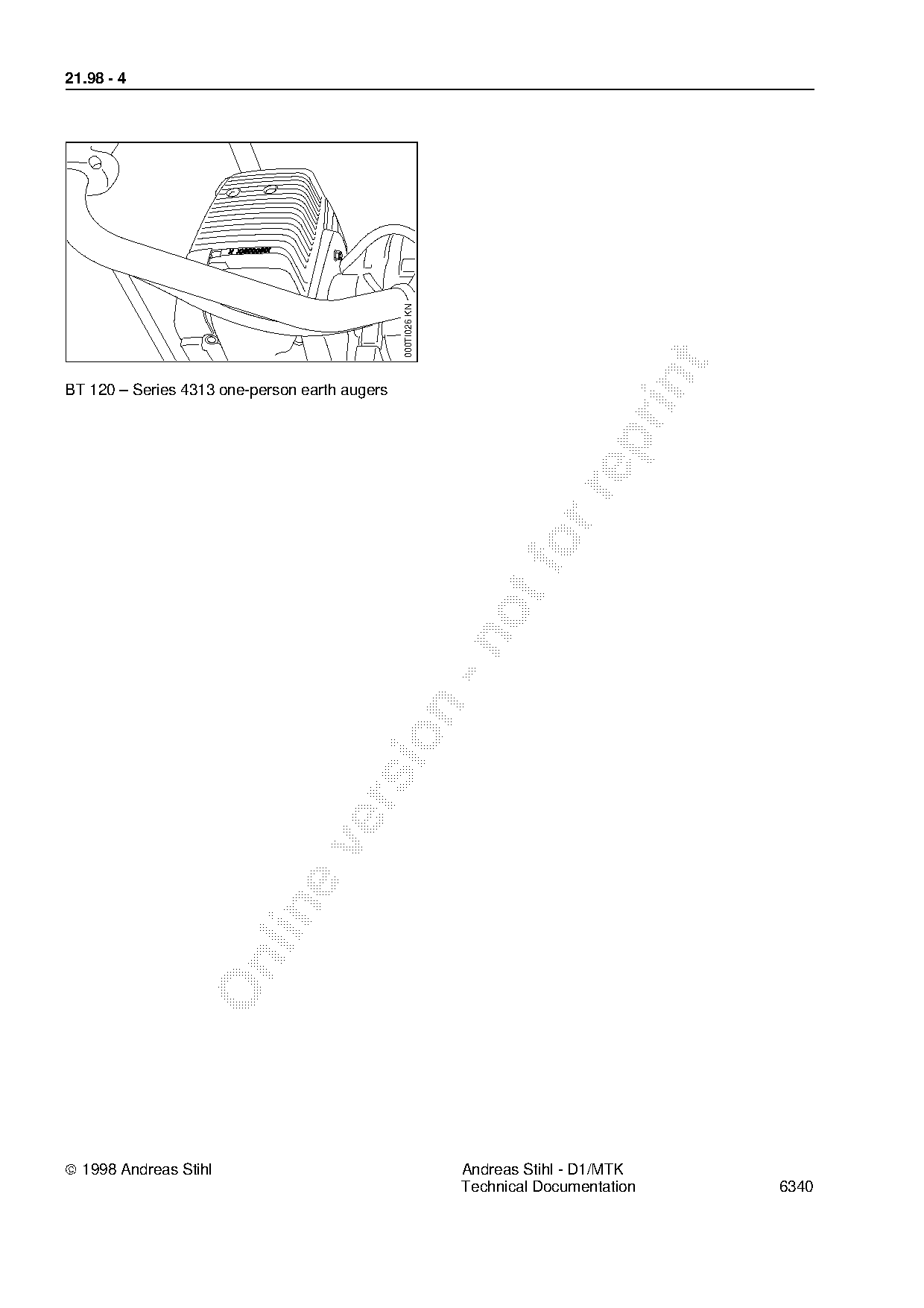
TI21/1998 shows the marking below the vented cover, behind the frame in the printed view.
No exact-model IPL link: These are illustrated machine-identity markings, not identified replacement parts or an exact IPL assembly/position. Retain the named example models and original diagrams on the bulletin; no assembly binding or shared-series variant expansion is established.
- Section 3 final illustration 000TI026 KN depicts BT 120: the horizontal X-number strip lies on the housing ledge immediately BELOW THE VENTED COVER, behind the foreground tubular frame in this view. The caption names series 4313 ONE-PERSON EARTH AUGERS. It does not describe a two-person auger or establish the location for every later BT variant.
- The X-number is a schematic placeholder, not a real machine serial, part number or changeover. The original diagram is the orientation reference; it does not specify removing the frame, a stamping/label material, an exact dimension or a serial decoding method.
- The page has this single diagram/caption and the footer: copyright 1998 Andreas Stihl, D1/MTK Technical Documentation, 6340. Blank remainder and footer were reviewed; 6340 is a documentation identifier, not a model or serial boundary.
- Historical 1998 source guidance, not a present-day serial decoder, parts-fitment determination or physical inspection. No hardware operation was performed.
Source: TI 21/1998, p. 2 · TI 21/1998, p. 4 — Page 4 complete BT120 drawing/caption and footer; page 2 section 3 scope.
No additional parts-table entry added.
Full text
Page 1 of 4
Text of page 1 — search, copy, screen readers
Technical Information

                                                                                                  21.98

Serial Number - an Important Sales and Service Instrument

1. Serial numbering

When serial numbering was extended to                   In this case three serial numbers with different
eight digits in 1981 (see TI 41.81), a ninth internal   country code digits will be quoted in the documen-
reference digit was added at the same time. This        tation if necessary.

digit prefixes the actual eight-digit serial number
on all chainsaws and power tools.                       2. Significance of serial number

The reference digit had no relevance in service         When a STIHL power tool is sold it is important
documentation at that time and has been generally       to record and report the serial number
shown as an “X” up to now.                              because it enables a product to be clearly

In view of the fact that STIHL products are now
                                                        identified and traced back to the time of its
                                                        manufacture.
manufactured at different locations in several
countries to supply world markets, the reference        In service, the serial number is used to assign
digit has been activated to represent the respective    a product to the relevant sales file. This is particu-

production location (country).                          larly important when it is necessary to determine
                                                        whether a repair is covered by warranty or not.
In the nine-digit number, the first digit always
represents the country in which the product was         The serial number is needed in the case of repairs

manufactured. The following code digits have            to ascertain the correct replacement parts where
been allocated at present:                              the component concerned has been subject to a

                                                        non-downward compatible engineering change
                                                        and the original part is still necessary on previous
Code digit                Country of manufacture        models.

1                         Germany                       In such cases the parts concerned are shown in
2                         USA                           the parts list in both the ’current’ column as well as
3                         Brazil

                                                        the “Spare Parts for Previous Models” column, but
6                         Japan                         with different part numbers. The serial number is
9                         Various                       used to select which column applies for the
                                                        replacement part concerned.

In future, the code digit for the country of manu-      An arrow adds the information “use up to” or “use
facture will be shown in the serial number in           from” to the Serial number.

service documentation (illustrated parts lists,
Technical Information bulletins, etc.)                  up to Serial number:   X XX XXX XXX
                                                        from Serial number: X XX XXX XXX
In the case of model versions which are manufac-
tured in different locations (e.g. 034 in Germany,      Therefore, the first step in any repair is to note the
USA and Brazil), engineering changes may be             machine (serial) number (all 9 digits).
introduced at different times and affect serial
numbers that are widely apart.
Page 2 of 4
Text of page 2 — search, copy, screen readers
21.98 - 2

3. Location of serial number

For design and production reasons, the serial                      The following illustrations show the location of the
numbers are applied in different ways and in                       serial number on one model of each of the most
different positions on the individual product groups               popular product groups.
(chainsaws, brushcutters/clearing saws, hedge
trimmers, cut-off machines, etc.).

                                                    000TI027 KN

                                                                                                                      000TI016 KN
017 chainsaw – Series 1129, 1130, 1132 occasio-
nal user and lightweight professional chainsaws
                                                                   E 160 – Series 1208 electric saws

                                                                                                                      000TI020 KN
                                                     000TI014 KN

023 chainsaw – Series 1123 homeowner                               FS 65-4 – Series 4170 lightweight brushcutters
chainsaws                                                          with four-stroke engine

                                                   000TI015 KN

                                                                                                                      000TI017 KN

036 chainsaw – Series 1121, 1122, 1124, 1125,                      FS 85 – Series 4133, 4137 heavy-duty
1127, 1128 farmer and professional chainsaws                       brushcutters
Page 3 of 4
Text of page 3 — search, copy, screen readers
21.98 - 3

                                              000TI018 KN

                                                                                                           000TI022 KN
FS 300 – Series 4128 and 4134 clearing saws                  BG 75 – Series 4227 handheld blowers

                                                                                                             000TI023 KN
                                              000TI019 KN

FS 500 – Series 4116 clearing saws                           BR 400 – Series 4203 backpack blowers and
                                                             sprayers

                                               000TI021 KN

                                                                                                             000TI024 KN

HS 80 – Series 4226 hedge trimmers                           TS 400 – Series 4221, 4223 cut-off machines
Page 4 of 4
Text of page 4 — search, copy, screen readers
21.98 - 4

                                               000TI026 KN

BT 120 – Series 4313 one-person earth augers

ã 1998 Andreas Stihl                                         Andreas Stihl - D1/MTK
                                                             Technical Documentation    6340
Most of these PDFs embed fonts with a shifted character map, so the text above was recovered rather than copied — read it as a faithful but imperfect transcription, and treat the page image above each block as the authority where the two disagree — the figures exist only there, because they are vector drawings that text extraction cannot keep.