Technical Information · issue 25 of 1999
STIHL two-stroke engine oil; STIHL HT plus Bio
Accessory changes & notes
Source-reviewed accessory relationships. These notes do not establish fitment to unnamed saw models. Availability statements belong to the bulletin’s date.
Historical fitment · Accessory
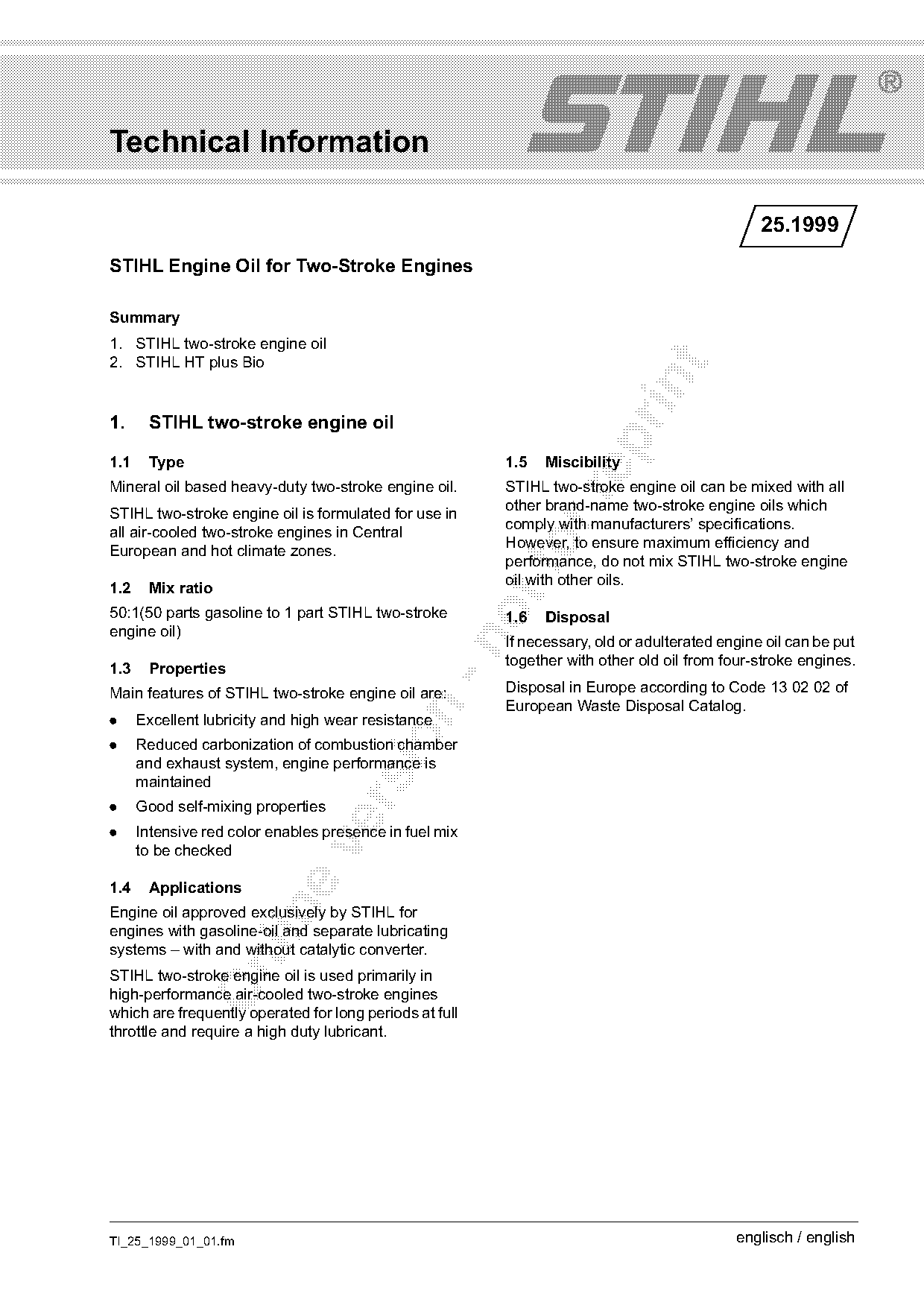
STIHL mineral two-stroke oil: 1999 formulation and fuel-mix limits
Red mineral oil, 50:1 gasoline-to-oil; retain historical package sizes, typical data and storage warnings.
- Type: mineral-oil-based heavy-duty two-stroke engine oil, formulated for air-cooled two-stroke engines in Central European and hot climate zones. The printed mix ratio is 50:1, meaning 50 parts gasoline to 1 part this STIHL two-stroke engine oil; it is not oil-to-gasoline and is not transferred to unidentified oils.
- The source describes approval exclusively by STIHL for gasoline-oil and separate-lubricating-system engines, with and without catalytic converter, primarily high-performance air-cooled engines frequently operated for long periods at full throttle. The premix ratio does not specify a separate oil-injection system setting.
- Manufacturer-reported properties: excellent lubricity and wear resistance, reduced combustion-chamber/exhaust carbonization while maintaining performance, good self-mixing, and intensive red color for checking oil presence. Color alone neither measures mix ratio nor verifies product identity; these are source claims, not project tests.
- Miscibility: may be mixed with other brand-name two-stroke oils complying with manufacturers’ specifications; nevertheless the source says not to mix with other oils for maximum efficiency and performance. Physical miscibility is not a blanket recommendation to combine products.
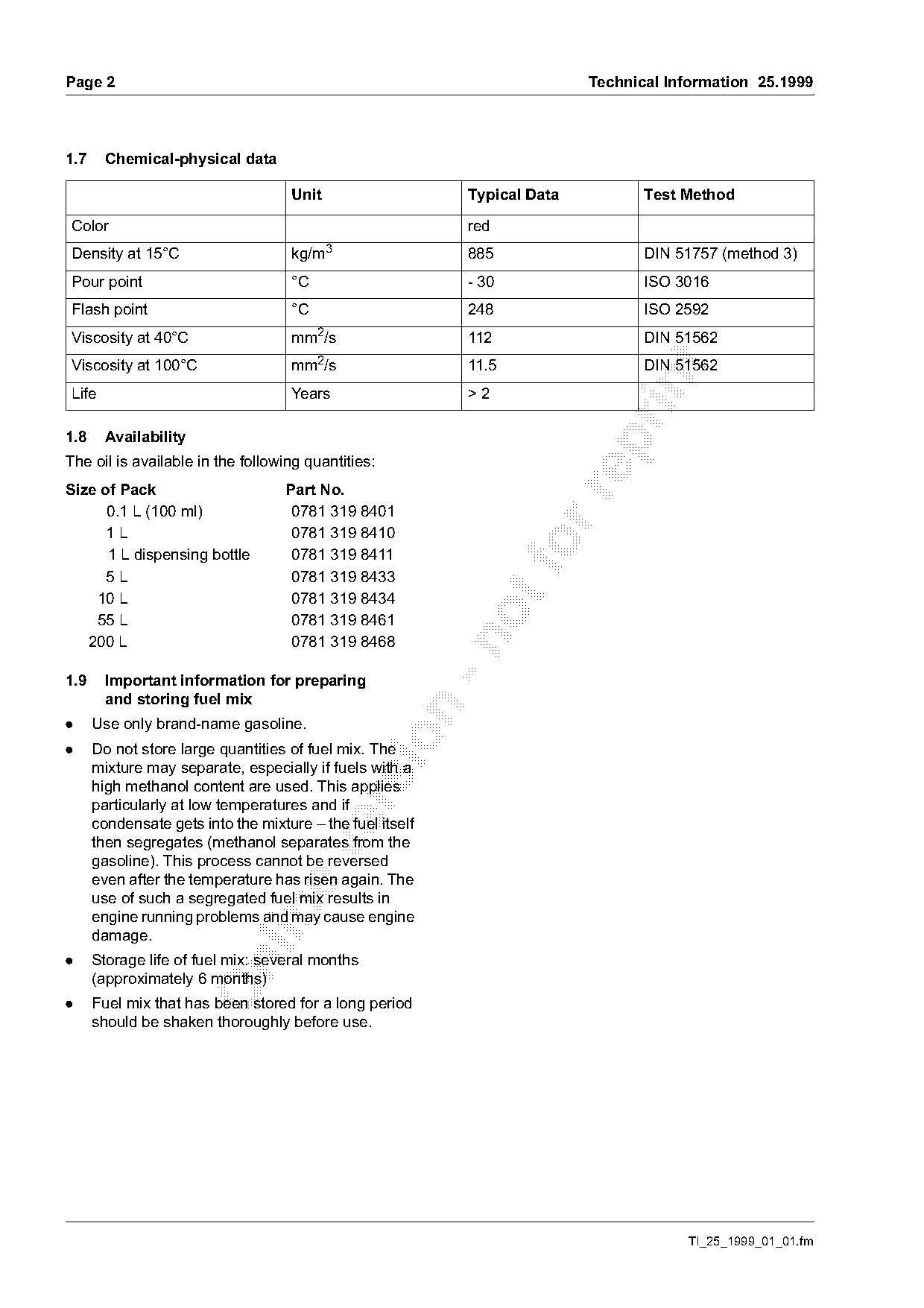
- Typical data, not guaranteed tolerances: red; density at 15°C 885 kg/m³, DIN 51757 (method 3); pour point −30°C, ISO 3016; flash point 248°C, ISO 2592; viscosity at 40°C 112 mm²/s and at 100°C 11.5 mm²/s, DIN 51562; oil life >2 years. Flash/pour points are material properties, not operating limits or a fire-safety guarantee.
- Historical 1999 formulation and package data, not an approval of present oils, a current warranty promise or exact-model compatibility. No machine or IPL assembly binding is inferred from the broad two-stroke application wording. These are engine oils, not bar-and-chain lubricants.
- Use only brand-name gasoline. Sections 1.9 and 2.9 warn against storing large quantities: fuel mix may separate, especially with high methanol content, low temperatures and condensate. Methanol can segregate from gasoline; a later temperature rise does not reverse that process. Such fuel can cause running problems and engine damage. This is a warning, not approval of a methanol content or an ethanol specification.
- The source gives fuel-mix storage as several months (approximately 6 months) and says to shake long-stored mix thoroughly before use. That historical guidance is not a universal current storage limit or a method to recover irreversibly segregated fuel. It is distinct from the greater-than-2-year oil-life table row; the source does not state sealed/opened storage conditions.
- Historical disposal wording in both sections permits old or adulterated engine oil to be put with old four-stroke engine oil if necessary and cites European Waste Disposal Catalog code 13 02 02. This records the 1999 source only, not current legal classification, permission to discharge oil or authority to mix arbitrary waste streams.
Source: TI 25/1999, p. 1 · TI 25/1999, p. 2 — 1.1–1.9 mineral two-stroke engine oil.
Part numbers (7)
- 0781 319 8401 — STIHL mineral two-stroke oil — 0.1 L (100 ml)Historical package; no current-stock claim · 1999 1.1–1.9 mineral two-stroke engine oil availability table
- 0781 319 8410 — STIHL mineral two-stroke oil — 1 LHistorical package; no current-stock claim · 1999 1.1–1.9 mineral two-stroke engine oil availability table
- 0781 319 8411 — STIHL mineral two-stroke oil — 1 L dispensing bottleHistorical package; no current-stock claim · 1999 1.1–1.9 mineral two-stroke engine oil availability table
- 0781 319 8433 — STIHL mineral two-stroke oil — 5 LHistorical package; no current-stock claim · 1999 1.1–1.9 mineral two-stroke engine oil availability table
- 0781 319 8434 — STIHL mineral two-stroke oil — 10 LHistorical package; no current-stock claim · 1999 1.1–1.9 mineral two-stroke engine oil availability table
- 0781 319 8461 — STIHL mineral two-stroke oil — 55 LHistorical package; no current-stock claim · 1999 1.1–1.9 mineral two-stroke engine oil availability table
- 0781 319 8468 — STIHL mineral two-stroke oil — 200 LHistorical package; no current-stock claim · 1999 1.1–1.9 mineral two-stroke engine oil availability table
Historical fitment · Accessory
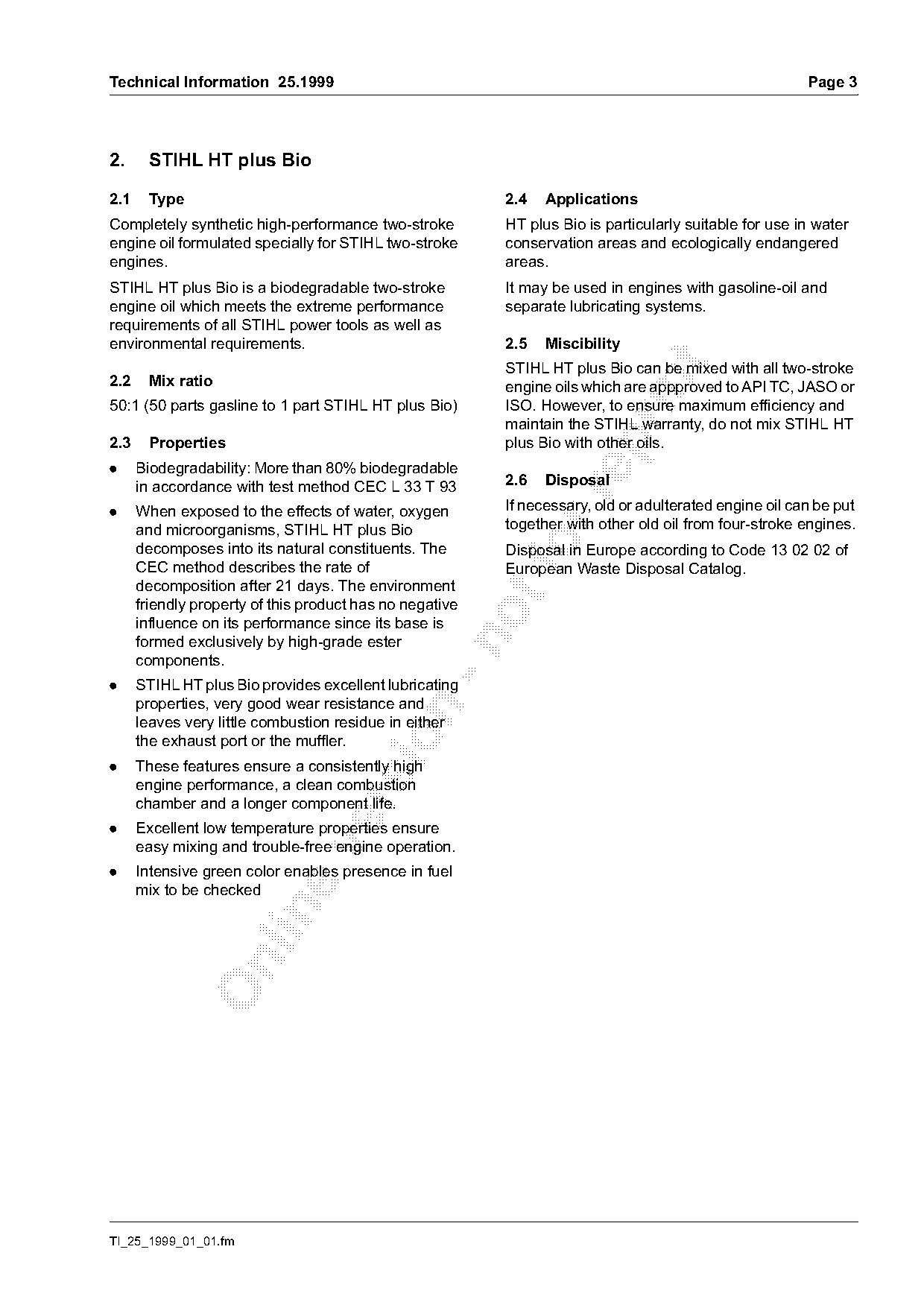
STIHL HT plus Bio: 1999 ester oil and biodegradability discrepancy
Green synthetic oil, 50:1 gasoline-to-oil; keep the narrative >80%/T93 and table 80%/A93 claims distinct.
- Type: completely synthetic high-performance two-stroke oil specially formulated for STIHL two-stroke engines. The source says it meets the extreme performance requirements of all STIHL power tools and environmental requirements; this is a dated manufacturer claim, not proof for later machines. Base components are described as exclusively high-grade esters. The mix ratio is 50:1: 50 parts gasoline to 1 part HT plus Bio.
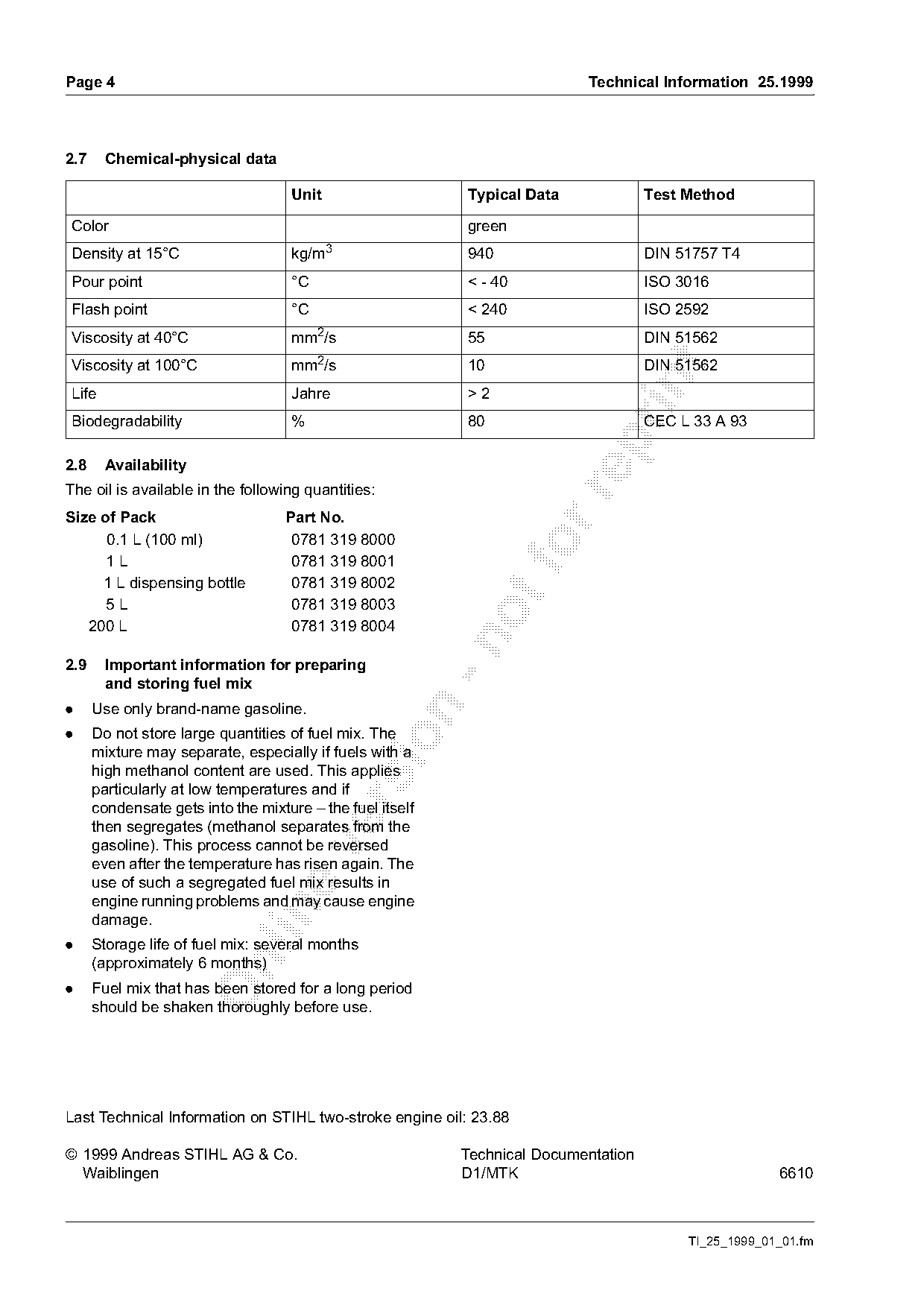
- Biodegradability discrepancy preserved: section 2.3 says more than 80% under CEC L 33 T 93 and describes decomposition after 21 days with water, oxygen and microorganisms. Section 2.7 instead prints 80% under CEC L 33 A 93. Neither the inequality nor the method suffix is silently normalized; no independent test resolves them. This is not an immediate, universal or complete biodegradation claim.
- Manufacturer-reported properties include excellent lubrication and wear resistance; very little exhaust-port/muffler residue; sustained engine performance, clean combustion chamber and longer component life; excellent low-temperature mixing/operation; and intensive green color for checking oil presence. The source says environmental properties do not impair performance. Color does not measure mix ratio or authenticate the oil.
- Applications: described as particularly suitable in water-conservation and ecologically endangered areas, and for gasoline-oil or separate-lubricating-system engines. This environmental-use claim is not permission to spill or discharge oil, and the premix ratio does not define an oil-injection setting.
- Miscibility: the source says it can mix with two-stroke oils approved to API TC, JASO or ISO, without specifying a JASO/ISO grade. It nevertheless says not to mix with other oils to ensure maximum efficiency and maintain the STIHL warranty. Preserve that 1999 warranty wording without making a present warranty promise or inventing missing grades.
- Typical data, not guaranteed tolerances: green; density at 15°C 940 kg/m³, DIN 51757 T4; pour point <−40°C, ISO 3016; flash point <240°C, ISO 2592; viscosity at 40°C 55 mm²/s and at 100°C 10 mm²/s, DIN 51562; life >2 years (the unit cell prints Jahre). The less-than signs are retained exactly, including flash point; no correction to a presumed minimum. Material flash/pour points are not operating limits or a fire-safety guarantee.
- Historical 1999 formulation and package data, not an approval of present oils, a current warranty promise or exact-model compatibility. No machine or IPL assembly binding is inferred from the broad two-stroke application wording. These are engine oils, not bar-and-chain lubricants.
- Use only brand-name gasoline. Sections 1.9 and 2.9 warn against storing large quantities: fuel mix may separate, especially with high methanol content, low temperatures and condensate. Methanol can segregate from gasoline; a later temperature rise does not reverse that process. Such fuel can cause running problems and engine damage. This is a warning, not approval of a methanol content or an ethanol specification.
- The source gives fuel-mix storage as several months (approximately 6 months) and says to shake long-stored mix thoroughly before use. That historical guidance is not a universal current storage limit or a method to recover irreversibly segregated fuel. It is distinct from the greater-than-2-year oil-life table row; the source does not state sealed/opened storage conditions.
- Historical disposal wording in both sections permits old or adulterated engine oil to be put with old four-stroke engine oil if necessary and cites European Waste Disposal Catalog code 13 02 02. This records the 1999 source only, not current legal classification, permission to discharge oil or authority to mix arbitrary waste streams.
Source: TI 25/1999, p. 3 · TI 25/1999, p. 4 — 2.1–2.9 HT plus Bio.
Part numbers (5)
- 0781 319 8000 — STIHL HT plus Bio — 0.1 L (100 ml)Historical package; no current-stock claim · 1999 2.1–2.9 HT plus Bio availability table
- 0781 319 8001 — STIHL HT plus Bio — 1 LHistorical package; no current-stock claim · 1999 2.1–2.9 HT plus Bio availability table
- 0781 319 8002 — STIHL HT plus Bio — 1 L dispensing bottleHistorical package; no current-stock claim · 1999 2.1–2.9 HT plus Bio availability table
- 0781 319 8003 — STIHL HT plus Bio — 5 LHistorical package; no current-stock claim · 1999 2.1–2.9 HT plus Bio availability table
- 0781 319 8004 — STIHL HT plus Bio — 200 LHistorical package; no current-stock claim · 1999 2.1–2.9 HT plus Bio availability table
Full text
Page 1 of 4
Text of page 1 — search, copy, screen readers
Technical Information

                                                                                                25.1999
STIHL Engine Oil for Two-Stroke Engines

Summary
1. STIHL two-stroke engine oil
2. STIHL HT plus Bio

1.     STIHL two-stroke engine oil

1.1    Type                                              1.5   Miscibility
Mineral oil based heavy-duty two-stroke engine oil.      STIHL two-stroke engine oil can be mixed with all

                                                         other brand-name two-stroke engine oils which
STIHL two-stroke engine oil is formulated for use in
                                                         comply with manufacturers’ specifications.
all air-cooled two-stroke engines in Central
                                                         However, to ensure maximum efficiency and
European and hot climate zones.
                                                         performance, do not mix STIHL two-stroke engine
                                                         oil with other oils.
1.2    Mix ratio
50:1(50 parts gasoline to 1 part STIHL two-stroke        1.6   Disposal
engine oil)
                                                         If necessary, old or adulterated engine oil can be put

                                                         together with other old oil from four-stroke engines.
1.3    Properties
Main features of STIHL two-stroke engine oil are:        Disposal in Europe according to Code 13 02 02 of
                                                         European Waste Disposal Catalog.

.     Excellent lubricity and high wear resistance

.     Reduced carbonization of combustion chamber
      and exhaust system, engine performance is
      maintained

.     Good self-mixing properties
.     Intensive red color enables presence in fuel mix

      to be checked

1.4    Applications

Engine oil approved exclusively by STIHL for
engines with gasoline-oil and separate lubricating
systems – with and without catalytic converter.

STIHL two-stroke engine oil is used primarily in
high-performance air-cooled two-stroke engines
which are frequently operated for long periods at full
throttle and require a high duty lubricant.

TI_25_1999_01_01.fm                                                                         englisch / english
Page 2 of 4
Text of page 2 — search, copy, screen readers
Page 2                                                                    Technical Information 25.1999

1.7     Chemical-physical data

                                    Unit                   Typical Data          Test Method

Color                                                      red
Density at 15°C                     kg/m3                  885                   DIN 51757 (method 3)
Pour point                          °C                     - 30                  ISO 3016
Flash point                         °C                     248                   ISO 2592
Viscosity at 40°C                   mm2/s                  112                   DIN 51562
Viscosity at 100°C                  mm2/s                  11.5                  DIN 51562

Life                                Years                  >2

1.8     Availability

The oil is available in the following quantities:
Size of Pack                        Part No.

      0.1 L (100 ml)                 0781 319 8401
      1L                             0781 319 8410
      1 L dispensing bottle
      5L
                                     0781 319 8411
                                     0781 319 8433
    10 L                             0781 319 8434
    55 L                             0781 319 8461
   200 L                             0781 319 8468

1.9     Important information for preparing
        and storing fuel mix

.     Use only brand-name gasoline.

.     Do not store large quantities of fuel mix. The
      mixture may separate, especially if fuels with a
      high methanol content are used. This applies

      particularly at low temperatures and if
      condensate gets into the mixture – the fuel itself
      then segregates (methanol separates from the

      gasoline). This process cannot be reversed
      even after the temperature has risen again. The
      use of such a segregated fuel mix results in

      engine running problems and may cause engine
      damage.
.     Storage life of fuel mix: several months

      (approximately 6 months)
.     Fuel mix that has been stored for a long period
      should be shaken thoroughly before use.

                                                                                      TI_25_1999_01_01.fm
Page 3 of 4
Text of page 3 — search, copy, screen readers
Technical Information 25.1999                                                                           Page 3

2.      STIHL HT plus Bio

2.1     Type                                              2.4   Applications
Completely synthetic high-performance two-stroke          HT plus Bio is particularly suitable for use in water
engine oil formulated specially for STIHL two-stroke      conservation areas and ecologically endangered
engines.                                                  areas.
STIHL HT plus Bio is a biodegradable two-stroke           It may be used in engines with gasoline-oil and
engine oil which meets the extreme performance            separate lubricating systems.
requirements of all STIHL power tools as well as
environmental requirements.                               2.5   Miscibility

                                                          STIHL HT plus Bio can be mixed with all two-stroke
2.2     Mix ratio

                                                          engine oils which are appproved to API TC, JASO or
50:1 (50 parts gasline to 1 part STIHL HT plus Bio)       ISO. However, to ensure maximum efficiency and
                                                          maintain the STIHL warranty, do not mix STIHL HT

2.3     Properties                                        plus Bio with other oils.
.     Biodegradability: More than 80% biodegradable
      in accordance with test method CEC L 33 T 93        2.6   Disposal

.     When exposed to the effects of water, oxygen        If necessary, old or adulterated engine oil can be put
      and microorganisms, STIHL HT plus Bio               together with other old oil from four-stroke engines.
      decomposes into its natural constituents. The
      CEC method describes the rate of
                                                          Disposal in Europe according to Code 13 02 02 of
                                                          European Waste Disposal Catalog.
      decomposition after 21 days. The environment
      friendly property of this product has no negative
      influence on its performance since its base is
      formed exclusively by high-grade ester

      components.
.     STIHL HT plus Bio provides excellent lubricating
      properties, very good wear resistance and

      leaves very little combustion residue in either

      the exhaust port or the muffler.
.     These features ensure a consistently high
      engine performance, a clean combustion
      chamber and a longer component life.

.     Excellent low temperature properties ensure
      easy mixing and trouble-free engine operation.

.     Intensive green color enables presence in fuel
      mix to be checked

TI_25_1999_01_01.fm
Page 4 of 4
Text of page 4 — search, copy, screen readers
Page 4                                                                     Technical Information 25.1999

2.7     Chemical-physical data

                                    Unit                   Typical Data              Test Method

Color                                                      green
Density at 15°C                     kg/m3                  940                       DIN 51757 T4
Pour point                          °C                     < - 40                    ISO 3016
Flash point                         °C                     < 240                     ISO 2592
Viscosity at 40°C                   mm2/s                  55                        DIN 51562
Viscosity at 100°C                  mm2/s                  10                        DIN 51562

Life                                Jahre                  >2
Biodegradability                    %                      80                        CEC L 33 A 93

2.8     Availability
The oil is available in the following quantities:

Size of Pack                        Part No.
      0.1 L (100 ml)                 0781 319 8000
      1L                             0781 319 8001
     1 L dispensing bottle           0781 319 8002
      5L                             0781 319 8003
   200 L                             0781 319 8004

2.9     Important information for preparing
        and storing fuel mix
.     Use only brand-name gasoline.

.     Do not store large quantities of fuel mix. The

      mixture may separate, especially if fuels with a
      high methanol content are used. This applies
      particularly at low temperatures and if

      condensate gets into the mixture – the fuel itself
      then segregates (methanol separates from the
      gasoline). This process cannot be reversed

      even after the temperature has risen again. The
      use of such a segregated fuel mix results in
      engine running problems and may cause engine

      damage.
.     Storage life of fuel mix: several months
      (approximately 6 months)

.     Fuel mix that has been stored for a long period
      should be shaken thoroughly before use.

Last Technical Information on STIHL two-stroke engine oil: 23.88

© 1999 Andreas STIHL AG & Co.                              Technical Documentation
  Waiblingen                                               D1/MTK                                      6610

                                                                                          TI_25_1999_01_01.fm
Most of these PDFs embed fonts with a shifted character map, so the text above was recovered rather than copied — read it as a faithful but imperfect transcription, and treat the page image above each block as the authority where the two disagree — the figures exist only there, because they are vector drawings that text extraction cannot keep.