Technical Information · issue 30 of 1999
ZAT 4 Ignition System Tester
Service-tool changes & notes
Source-reviewed tool relationships, not saw-model compatibility or a verified kit inventory. Availability statements belong to the bulletin’s date.
Service note · Service tool
ZAT 4 ignition tester: lamp interpretation and engine-start warning
The 1999 inline tester indicates ignition voltage; an unlit lamp points to ignition or wiring, not automatically a failed module. The engine may start and accelerate.
- TI30/1999 introduces the ZAT 4 as a new, inexpensive ignition system tester for spark ignition engines, part 5910 850 4503. These are historical introduction/price descriptions, not current availability or a measured price. No exact engine model, serial cutoff or later-system compatibility is named.
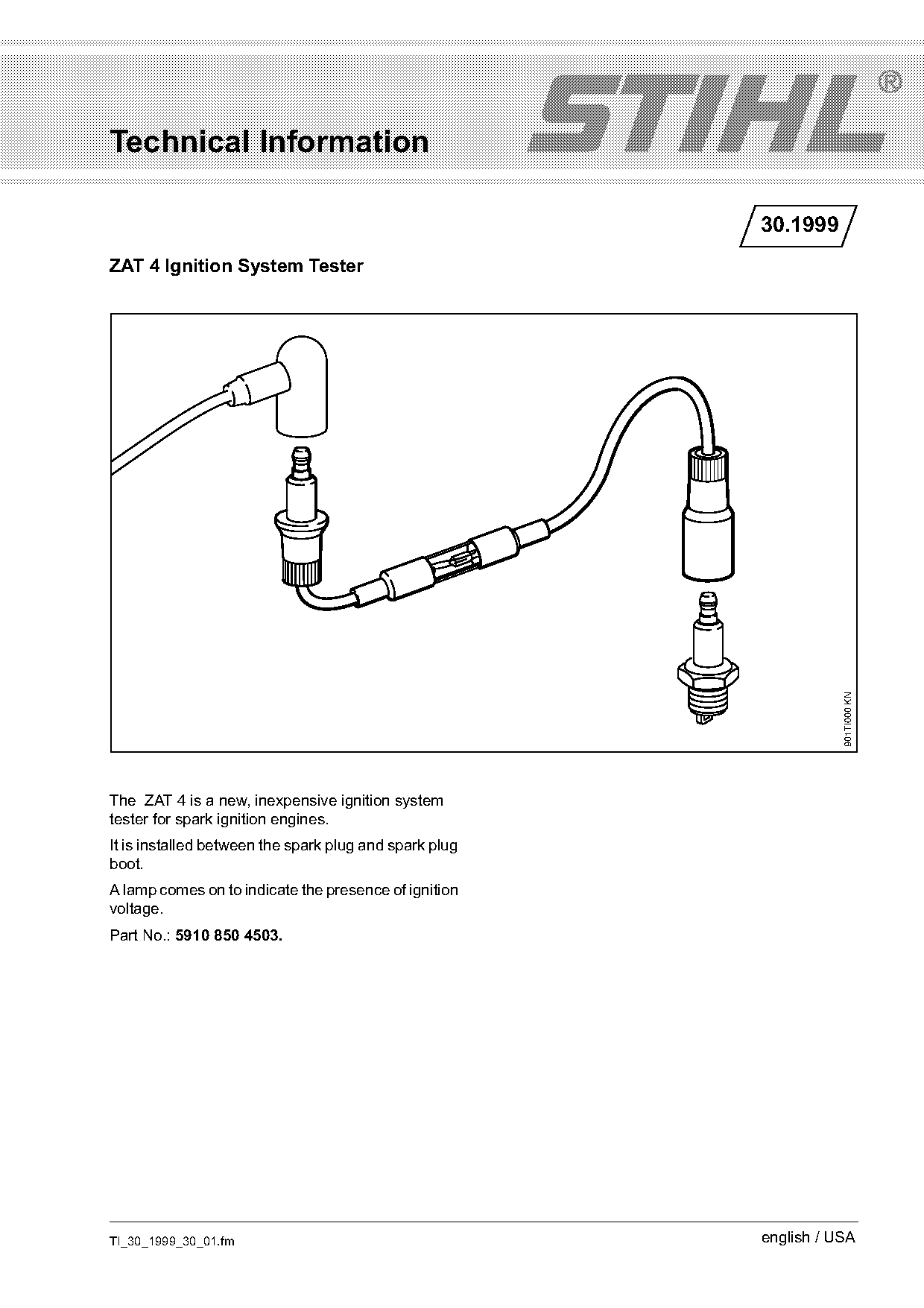
- The tester is installed between the spark plug and the spark plug boot. Page 1 illustration 901TI000 KN depicts the original boot connecting to one tester end and the tester boot connecting to the plug, with the indicator in the intervening lead. The drawing establishes this inline connection, not an alternative grounding arrangement, adapter identity or connector dimension.
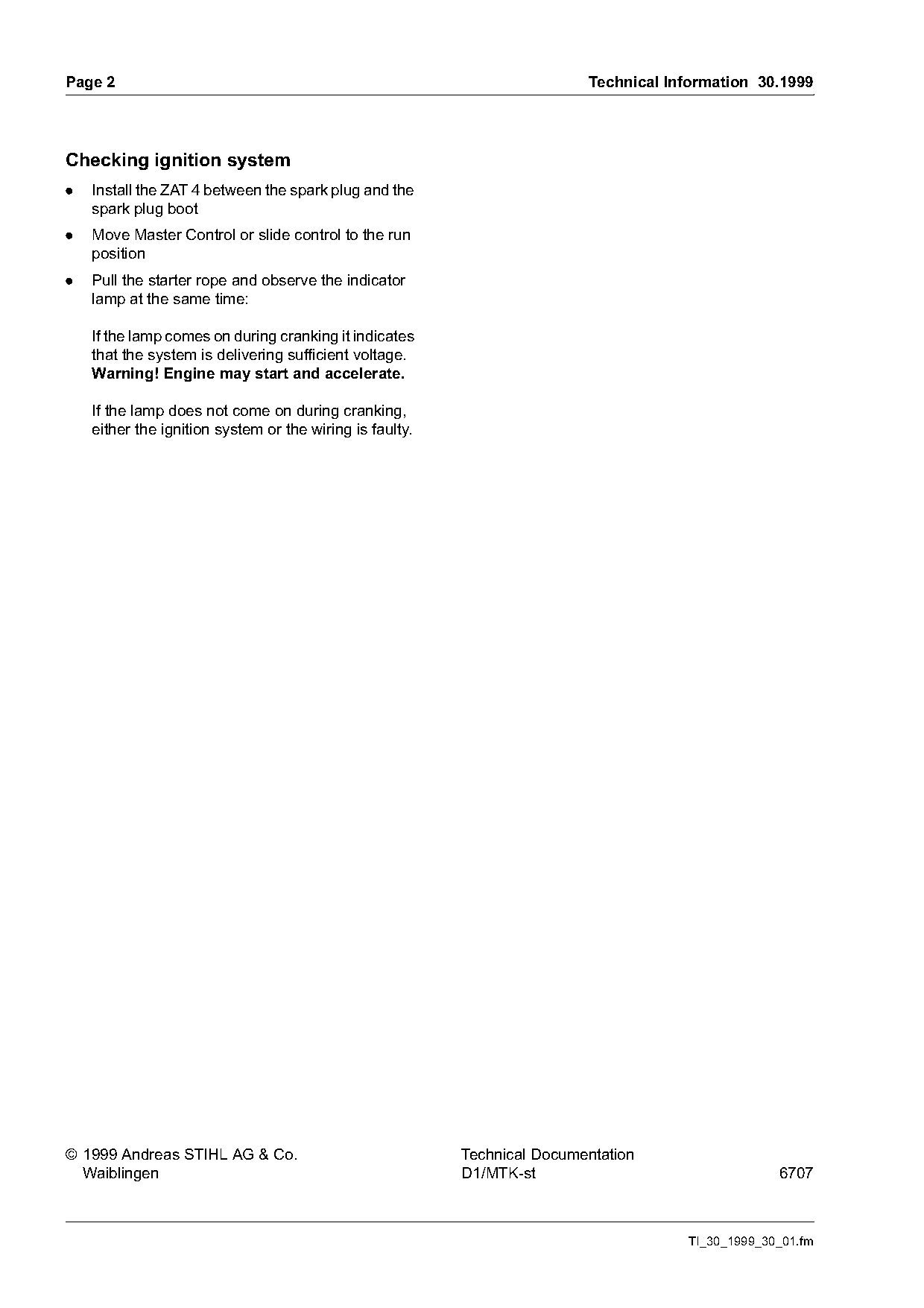
- The historical checking sequence on page 2 is to install the tester between plug and boot, move the Master Control or slide control to the run position, then pull the starter rope while observing the indicator lamp. Warning: the engine may start and accelerate. This warning belongs with the cranking step; it is not a no-start test or permission for unattended operation.
- Page 1 describes the lamp as indicating the presence of ignition voltage. Page 2 says that a lamp which comes on during cranking indicates the system is delivering sufficient voltage. No numerical voltage threshold, spark energy, ignition timing, plug firing under compression or complete ignition-health verdict is supplied; a lit lamp is not proof of a successful repair.
- If the lamp does not come on during cranking, the bulletin identifies either the ignition system or the wiring as faulty. It does not isolate the ignition module, prove the spark plug faulty or authorize component replacement from this observation alone. Do not turn the two-way fault statement into a module-only diagnosis.
- This is source-reviewed historical tool guidance, not a performed hardware test or a model-specific service procedure. No current machine, tester condition, safe setup or physical compatibility was verified. There is no delegated manual/source dependency in this two-page TI; unspecified thresholds and model coverage remain explicit limits, not invented values or artificial source gaps.
Source: TI 30/1999, p. 1 · TI 30/1999, p. 2 — Complete pages 1–2: tester identity and connection illustration 901TI000 KN; Checking ignition system, both lamp outcomes and engine-start warning.
Part numbers (1)
- 5910 850 4503 — ZAT 4 ignition system testerHistorical tester identification; not a replacement ignition component · TI30/1999 spark-ignition-engine test; no exact model or connector-variant binding
Full text
Page 1 of 2
Text of page 1 — search, copy, screen readers
Technical Information

                                                        30.1999
ZAT 4 Ignition System Tester

                                                                   901TI000 KN
The ZAT 4 is a new, inexpensive ignition system
tester for spark ignition engines.
It is installed between the spark plug and spark plug
boot.
A lamp comes on to indicate the presence of ignition
voltage.
Part No.: 5910 850 4503.

TI_30_1999_30_01.fm                                     english / USA
Page 2 of 2
Text of page 2 — search, copy, screen readers
Page 2                                                                    Technical Information 30.1999

Checking ignition system
.   Install the ZAT 4 between the spark plug and the
    spark plug boot
.   Move Master Control or slide control to the run
    position
.   Pull the starter rope and observe the indicator
    lamp at the same time:

    If the lamp comes on during cranking it indicates
    that the system is delivering sufficient voltage.
    Warning! Engine may start and accelerate.

    If the lamp does not come on during cranking,
    either the ignition system or the wiring is faulty.

© 1999 Andreas STIHL AG & Co.                             Technical Documentation
  Waiblingen                                              D1/MTK-st                                6707

                                                                                      TI_30_1999_30_01.fm
Most of these PDFs embed fonts with a shifted character map, so the text above was recovered rather than copied — read it as a faithful but imperfect transcription, and treat the page image above each block as the authority where the two disagree — the figures exist only there, because they are vector drawings that text extraction cannot keep.